Main features and benefits
Clinical Relevance - Scopolamine-induced dry eye mimics the human condition by reducing tear production through muscarinic receptor blockade.
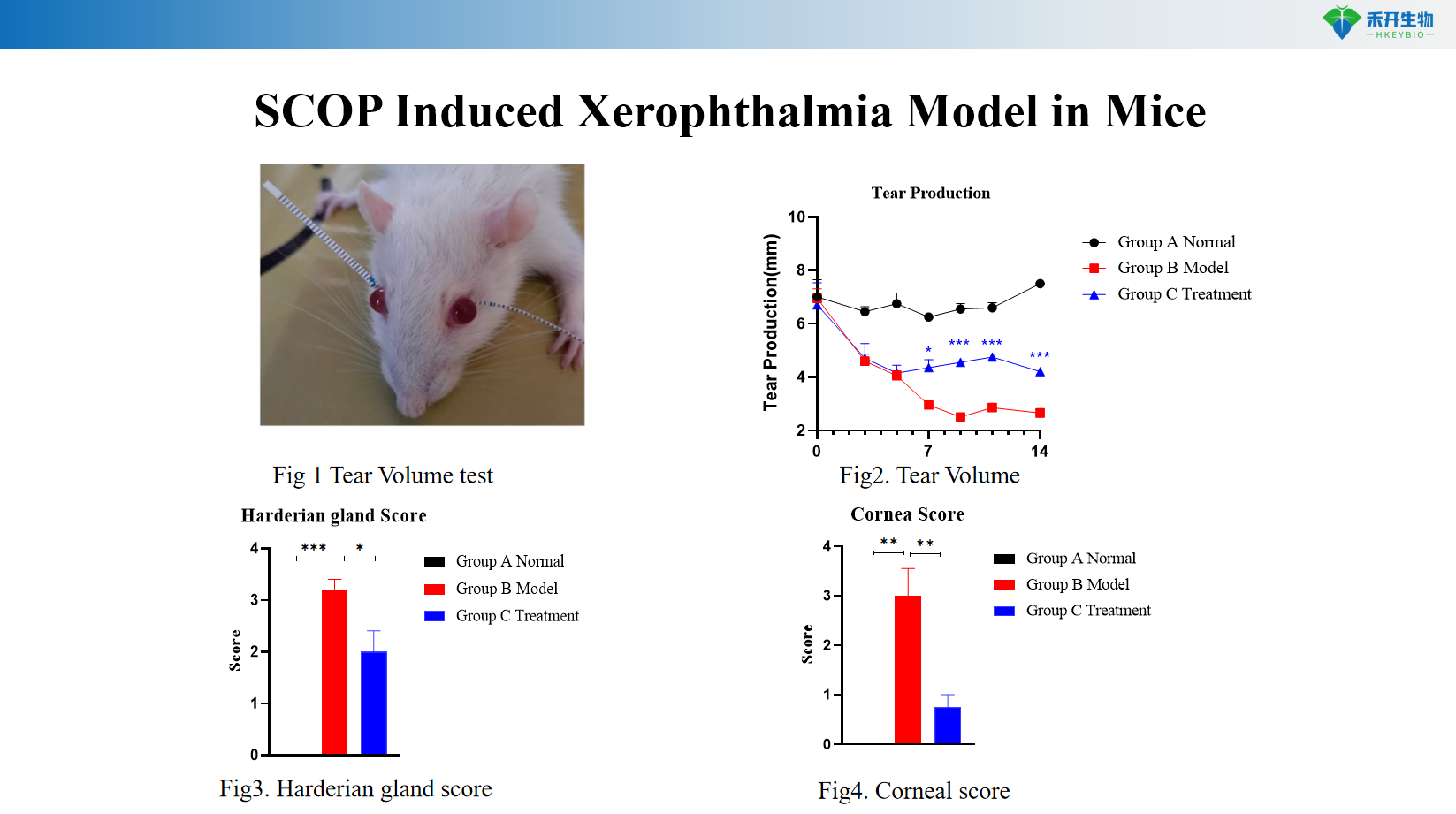
Quantifiable endpoints – Tear volume measurement (phenol red line test or Schirmer test), corneal fluorescein stain score, Harderian gland histopathology (H&E), ocular surface imaging.
Well-characterized model —widely used to evaluate tear replacement formulations, anti-inflammatory drugs, and lacrimal gland stimulants.
Translational Value – Ideal for testing tear secretagogues, lubricants, cyclosporine A, lifitegrast and anti-inflammatory biologics.
IND Ready Packet – Research can be conducted in accordance with GLP principles.
Technical data and verification
Representative data from our scopolamine-induced mouse dry eye model:
SCOP-induced dry eye model in mice
Application areas
• Efficacy testing of tear substitutes, lubricants and ocular surface protectants
• Evaluation of anti-inflammatory drugs (cyclosporine A, rivulast, corticosteroids) for the treatment of dry eye disease
• Target validation of lacrimal gland function and tear secretion pathway
• Biomarker discovery (tear osmolality, inflammatory cytokines)
• Pharmacology and toxicology studies to support IND
Model specifications
scope | Specification |
Species/Strain | BALB/c mice (other strains available upon request) |
induction method | Subcutaneous or intraperitoneal injection of scopolamine (SCOP) 4 times daily for 5-10 days |
study time | 7–14 days (induction + treatment phase) |
critical endpoint | Tear volume (phenol red line test), corneal fluorescein staining score, Harderian gland histopathology (H&E), ocular surface imaging, optional: tear cytokine levels, goblet cell density |
packet | Raw data, analysis reports, clinical photos, histology slides, bioinformatics (optional) |
❓ FAQ
Q: How does scopolamine induce dry eye syndrome?
Answer: Scopolamine is a muscarinic acetylcholine receptor antagonist that blocks parasympathetic nerve input to the lacrimal gland, reduces tear secretion and changes tear film composition.
Q: What are the key similarities to human dry eye?
A: This model exhibits reduced tear production, corneal epithelial damage (fluorescein staining), and Harderian gland inflammation, very similar to human aqueous dry eye.
Q: Can this model be used for IND support studies?
Answer: Yes. Studies can be conducted according to GLP principles for regulatory submissions (FDA, EMA).
Q: Do you offer customized study protocols (e.g., different dosing frequencies, combined with environmental stress)?
Answer: Of course. Our scientific team customizes scopolamine dosing regimens, treatment plans, and endpoint analyzes based on your specific drug candidate.


