Main features and benefits
Clinical relevance —BLM-induced skin fibrosis recapitulates the dermal thickening, collagen accumulation, and autoantibody production of human SSc.
Mechanistically driven —BLM induces DNA damage, oxidative stress, and inflammation, leading to fibroblast activation and excessive collagen deposition.
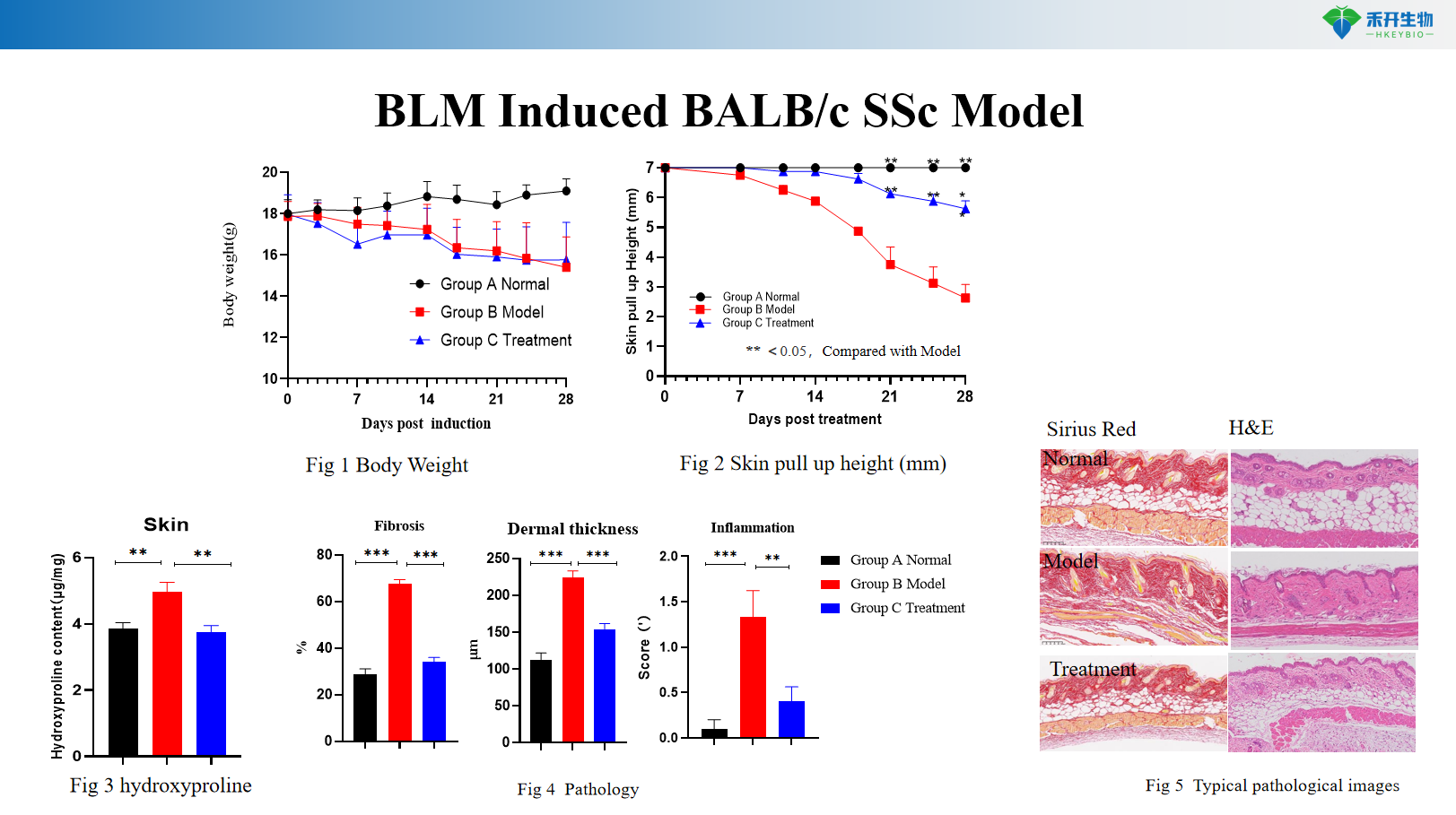
Comprehensive endpoints - body weight, skin pull-up height (mm), hydroxyproline content (collagen quantification), histopathology (HE, Sirius red), dermal thickness measurement.
Translational Value – Ideal for testing antifibrotic drugs (nintedanib, pirfenidone), TGF-β inhibitors, tyrosine kinase inhibitors, and immunomodulators.
IND Ready Packet – Research can be conducted in accordance with GLP principles.
Technical data and verification
BLM-induced BALB/c SSc model
Application areas
• Efficacy testing of antifibrotic drugs (nintedanib, pirfenidone, TGF-β inhibitors, galectin-3 inhibitors)
• Evaluation of tyrosine kinase inhibitors (imatinib, dasatinib) and immunomodulators (corticosteroids, mycophenolate mofetil)
• Target validation of fibrotic pathways (collagen synthesis, fibroblast activation)
• Biomarker discovery (hydroxyproline, collagen markers, inflammatory mediators)
• Pharmacology and toxicology studies to support IND
Model specifications
scope | Specification |
Species/Strain | BALB/c mouse |
induction method | Intraepithelial injection of bleomycin (BLM, 50–100 μL, 0.5–1 mg/mL solution) into shaved back skin 2–3 times per week for 3–6 weeks |
study time | 3–8 weeks (induction + treatment phase) |
critical endpoint | Body weight, skin lift height (mm) as a measure of skin thickness/fibrosis, hydroxyproline content (collagen quantification), skin histopathology (HE and Sirius red staining with dermal thickness and collagen deposition scores) |
| positive control | Nintedanib or pirfenidone may be used as reference antifibrotic compounds |
| packet | Raw data, analysis report, histological sections (HE, Sirius red), hydroxyproline measurement results, bioinformatics (optional) |
❓ FAQ
Q: How does bleomycin induce skin fibrosis?
A: Bleomycin induces DNA damage and oxidative stress in dermal fibroblasts and inflammatory cells, leading to activation of TGF-β signaling, fibroblast proliferation, and excessive collagen deposition, thereby reproducing fibrosis in human SSc.
Q: What are the key similarities to systemic sclerosis in humans?
A: This model exhibits dermal thickening, increased collagen deposition, elevated hydroxyproline, and histopathological changes (HE, Sirius red) that are very similar to human SSc skin fibrosis.
Q: Can this model be used for IND support studies?
Answer: Yes. Studies can be conducted according to GLP principles for regulatory submissions (FDA, EMA).
Q: Do you offer customized study protocols (e.g., different BLM doses, injection sites, treatment plans)?
Answer: Of course. Our scientific team customizes BLM dosing regimens, injection regimens, and endpoint analyzes based on your specific drug candidate.
Q: What is the typical timeline for a pilot efficacy study?
A: Pilot studies to induce fibrosis typically last 4-6 weeks and begin treatment at or after disease onset.


