Main features and benefits
Clinically Relevant – The weight loss contusion model simulates human traumatic SCI, with primary mechanical injury and secondary inflammatory cascades.
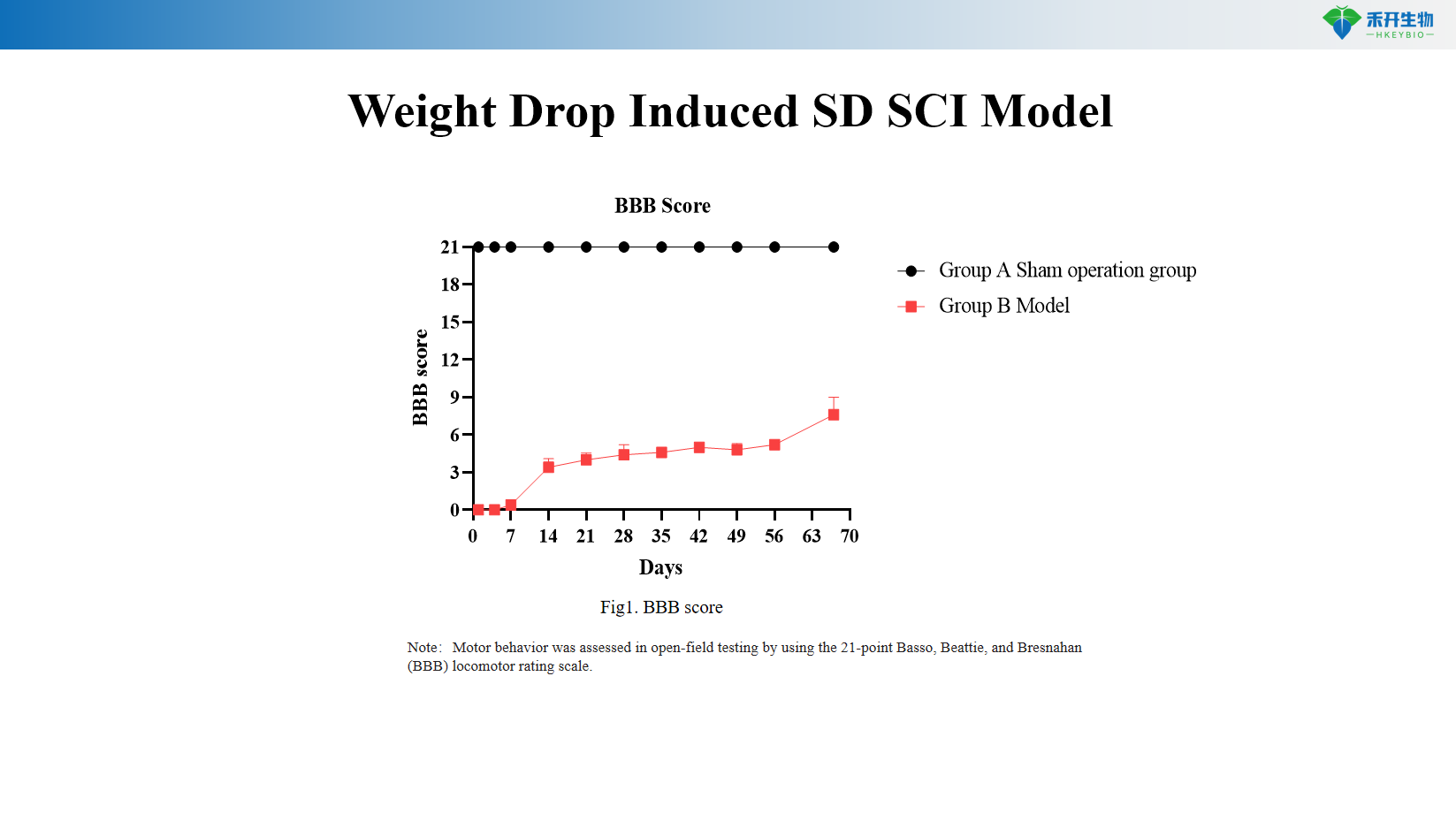
Quantifiable endpoints – BBB motor score (0-21 scale), spinal cord histopathology (cavitated areas, surviving tissue), immunohistochemistry (neurons, axons, glia).
Repeatable – Standardized weight loss parameters ensure consistent injury severity throughout the experiment.
Translational value – ideal for testing neuroprotective agents, anti-inflammatory drugs, stem cell therapies and regenerative medicine approaches.
IND Ready Packet – Research can be conducted in accordance with GLP principles.
Technical data and verification
SD SCI model caused by weight loss
Application areas
• Efficacy testing of neuroprotective agents (methylprednisolone, riluzole, minocycline)
• Evaluation of anti-inflammatory drugs, stem cell therapies (MSC, neural stem cells) and regenerative strategies
• Target validation of secondary injury pathways (inflammation, oxidative stress, excitotoxicity)
• Biomarker discovery (neurofilament light chain, inflammatory mediators)
• Pharmacology and toxicology studies to support IND
Model specifications
scope | Specification |
Species/Strain | Sprague-Dawley (SD) rat |
induction method | Laminectomy (T9–T10) followed by lowering a weight (e.g., lowering a 10 g rod from a height of 25–50 mm) onto the exposed spinal cord |
study time | 1–8 weeks (acute to chronic phase) |
critical endpoint | BBB motor score (0-21 scale, open field assessment), spinal cord histopathology (cavitated areas, spared tissue), immunohistochemistry (neurons, axons, astrocytes, microglia), optional: electrophysiology (motor evoked potentials), magnetic resonance imaging (MRI) |
packet | Raw data, analysis report, BBB score curve, histology slides, IHC images, bioinformatics (optional) |
❓ FAQ
Q: How does the weight loss model induce spinal cord injury?
A: After laminectomy, a controlled weight is dropped from a precise height onto the exposed spinal cord, causing a reproducible contusion. This mimics human spinal cord injury, with first mechanical injury followed by secondary inflammatory cascades, axonal degeneration and gliosis.
Q: What is a BBB score and how is it evaluated?
A: The Basso, Beattie, and Bresnahan (BBB) scale is a 21-point open field movement rating scale used to evaluate hindlimb movement, coordination, and weight support. Scores range from 0 (complete paralysis) to 21 (normal movement).
Q: Can this model be used for IND support studies?
Answer: Yes. Studies can be conducted according to GLP principles for regulatory submissions (FDA, EMA).
Q: Do you offer customized study protocols (e.g., different injury severities, treatment times)?
Answer: Of course. Our scientific team tailors weight loss parameters (height/weight), injury severity (mild, moderate, severe), treatment options (acute, subacute, chronic) and endpoint analysis to your specific drug candidate.
Q: What is the typical timeline for a pilot efficacy study?
A: Acute studies are typically performed 1-2 weeks after injury; long-term studies assessing regeneration may extend to 4-8 weeks.


