Main features and benefits
Clinical Relevance – Overview of human PBC: AMA production, bile duct disruption, portal inflammation, and elevated inflammatory cytokines.
Mechanism-driven —Molecular mimicry between xenobiotic-modified 2OA and autoantigen sulfonylated PDC-E2 disrupts immune tolerance and induces PBC-like pathology.
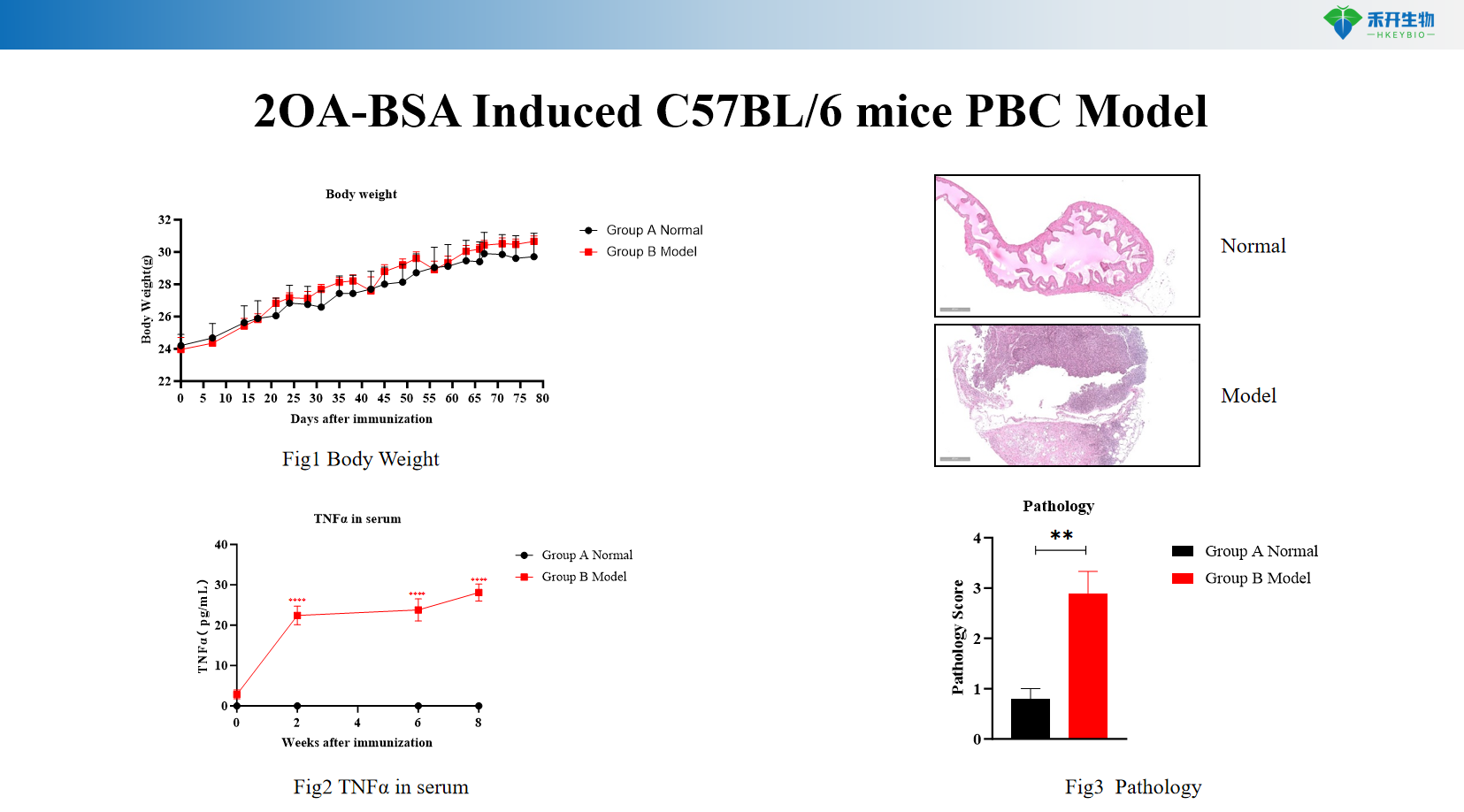
Composite endpoint – body weight, serum TNF-α and IFN-γ levels, liver histopathology (HE) and bile duct score, AMA testing (optional).
Translational Value – Ideal for testing immunomodulators (corticosteroids, mycophenolate mofetil), bile acid therapies (UDCA), and biologics targeting inflammatory pathways.
IND Ready Packet – Research can be conducted in accordance with GLP principles.
Technical data and verification
2OA-BSA induced C57BL/6 mouse PBC model
Application areas
• Testing the efficacy of immunomodulators (corticosteroids, mycophenolate mofetil, azathioprine) in the treatment of autoimmune cholangitis
• Evaluation of bile acid therapy (ursodeoxycholic acid, obeticholic acid) and anticholestasis drugs
• PBC molecular modeling and target validation of autoimmune pathways
• Biomarker discovery (AMA, cytokine signature, bile duct injury markers)
• Pharmacology and toxicology studies to support IND
Model specifications
scope | Specification |
Species/Strain | C57BL/6 mouse |
induction method | Immunization with bovine serum albumin (2OA-BSA)-conjugated 2-octynoic acid emulsified in complete Freund's adjuvant (CFA) and booster injections |
study time | 8-12 weeks (immunization + treatment phase) |
critical endpoint | Body weight, serum TNF-α and IFN-γ levels (ELISA), liver histopathology (HE staining and bile duct inflammation score), optional: anti-mitochondrial antibody (AMA) titer, CK19 (biliary epithelial) immunohistochemistry, serum alkaline phosphatase (ALP) |
packet | Raw data, analysis report, histological sections, ELISA results, bioinformatics (optional) |
❓ FAQ
Question: How does 2OA-BSA induce PBC in mice?
Answer: 2OA (2-octynoic acid) is a xenobiotic whose structure mimics the lipoic acid portion of the autoantigen PDC-E2. 2OA-BSA immunization disrupts immune tolerance through molecular mimicry, leading to the activation of autoreactive T cells and the production of antimitochondrial antibodies (AMA), which target bile duct epithelial cells and cause PBC-like pathology.
Q: What are the main similarities to human PBC?
A: This model exhibits AMA production, bile duct inflammation, portal infiltration, elevated inflammatory cytokines (TNF-α, IFN-γ), and liver histopathology consistent with human PBC, making it a valuable tool for studying disease mechanisms and testing treatments.
Q: Do you offer customized study protocols (e.g., different immunization schedules, dosing regimens)?
Answer: Of course. Our scientific team tailors immunization regimens, treatment plans and endpoint analyzes to your specific drug candidate.
Q: What is the typical timeline for a pilot efficacy study?
A: Pilot studies are usually conducted 8-12 weeks after immunization and include induction, treatment, and endpoint analysis.


