Key Features & Benefits
Clinically relevant – Scopolamine-induced dry eye mimics human condition by reducing tear production via muscarinic receptor blockade.
Quantifiable endpoints – Tear volume measurement (phenol red thread test or Schirmer test), corneal fluorescein staining score, Harderian gland histopathology (H&E), ocular surface imaging.
Well-characterized model – Widely used for evaluating tear substitute formulations, anti-inflammatory drugs, and lacrimal gland stimulants.
Translational value – Ideal for testing tear secretagogues, lubricants, cyclosporine A, lifitegrast, and anti-inflammatory biologics.
IND-ready data packages – Studies can be conducted in accordance with GLP principles.
Technical Data & Validation
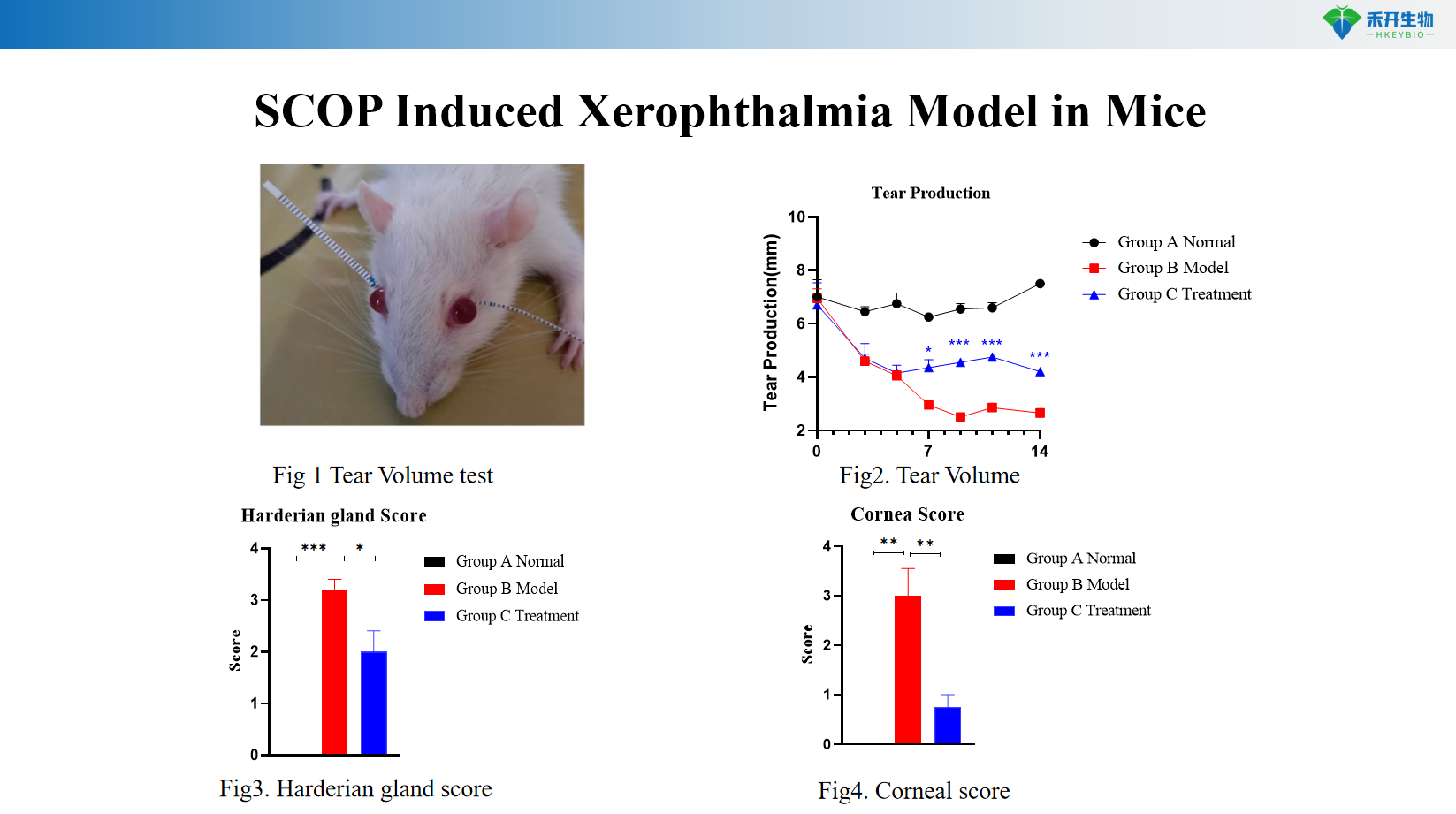
Representative data from our Scopolamine Induced Mouse Dry Eye model:
SCOP Induced Xerophthalmia Model in Mice
Applications
• Efficacy testing of tear substitutes, lubricants, and ocular surface protectants
• Evaluation of anti-inflammatory drugs (cyclosporine A, lifitegrast, corticosteroids) for dry eye disease
• Target validation for lacrimal gland function and tear secretion pathways
• Biomarker discovery (tear osmolarity, inflammatory cytokines)
• IND-enabling pharmacology and toxicology studies
Model Specifications
Parameter | Specification |
Species/Strain | BALB/c mouse (other strains available upon request) |
Induction method | Subcutaneous or intraperitoneal injection of scopolamine (SCOP), 4 times daily for 5–10 days |
Study duration | 7–14 days (induction + treatment phase) |
Key endpoints | Tear volume (phenol red thread test), corneal fluorescein staining score, Harderian gland histopathology (H&E), ocular surface imaging, optional: tear cytokine levels, goblet cell density |
Data package | Raw data, analysis reports, clinical photographs, histology slides, bioinformatics (optional) |
❓ Frequently Asked Questions
Q1: What dry eye model do you provide? A1: We offer the scopolamine (SCOP)-induced xerophthalmia model using BALB/c mice, a classic preclinical model for dry eye research.
Q2: What is the modeling mechanism? A2: Scopolamine acts as a muscarinic antagonist to block nerve pathways of lacrimal glands, which reduces tear secretion and changes tear composition, successfully simulating human dry eye symptoms.
Q3: What evaluation indicators are adopted? A3: We mainly detect tear volume and take ocular surface images. H&E staining is performed to assess pathological changes of cornea and Harderian gland.
Q4: What is the modeling procedure and cycle? A4: Mice are raised in a low-humidity environment and receive scopolamine four times per day starting from Day 0. The whole experiment lasts for 14 days.
Q5: What are the advantages and applications of this model? A5: This model features stable symptoms, simple operation and high reproducibility. It is widely used for efficacy screening and preclinical evaluation of ophthalmic drugs for dry eye treatment.


