Key Features & Benefits
Clinically relevant – Recapitulates human DTH reactions with T cell-mediated inflammation, Th1 cytokine profile, and local swelling.
Multiple antigens – Hapten (OXA) and protein antigen (OVA) models available for different research applications.
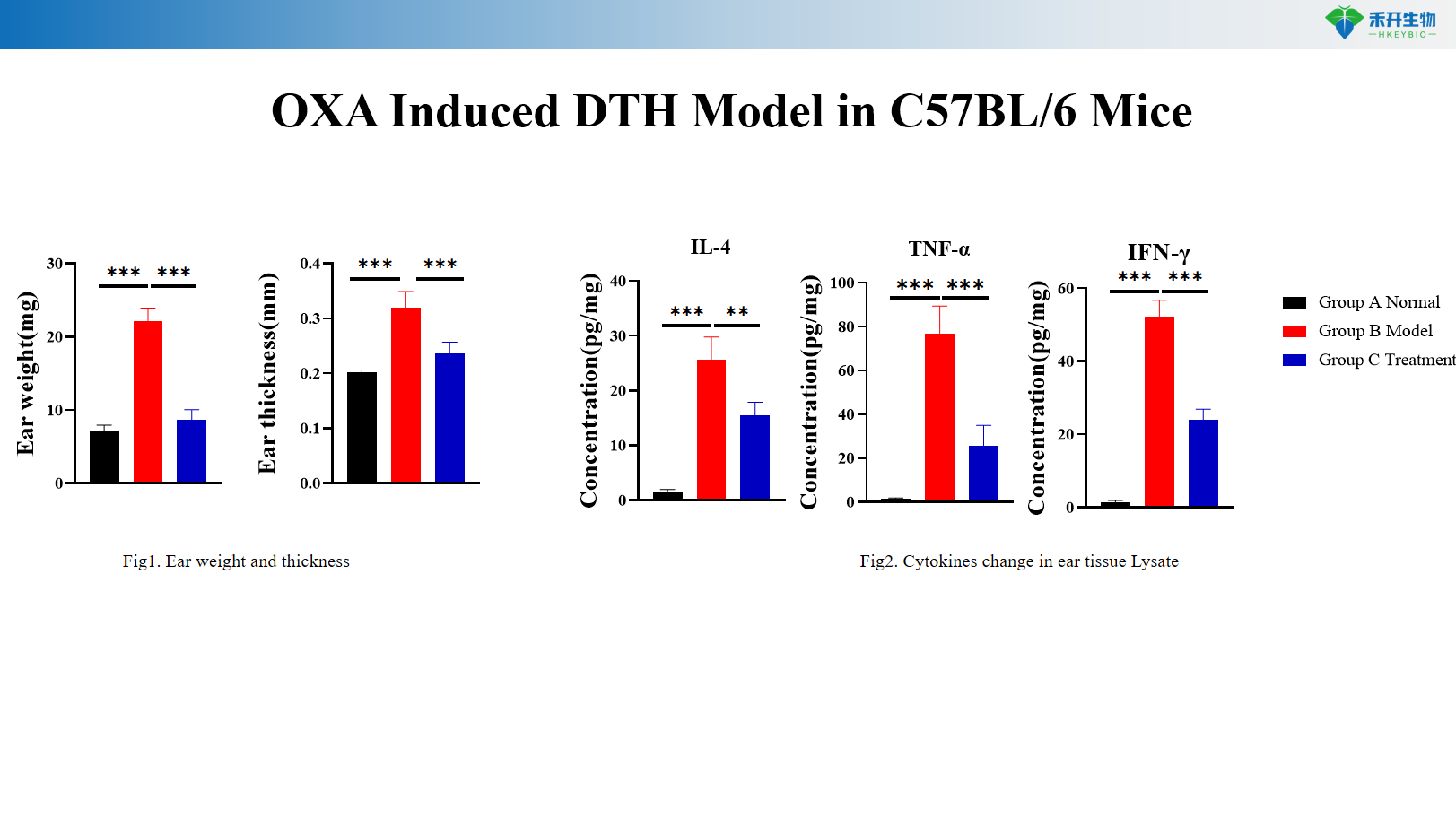
Quantifiable endpoints – Ear weight and thickness measurements, cytokine profiling (IFN-γ, TNF-α, IL-4) in ear tissue lysate.
Translational value – Ideal for testing immunomodulators targeting T cell responses, including immunosuppressants (corticosteroids, calcineurin inhibitors) and biologics.
IND-ready data packages – Studies can be conducted in accordance with GLP principles.
Technical Data & Validation
OXA Induced DTH Model in C57BL/6 Mice
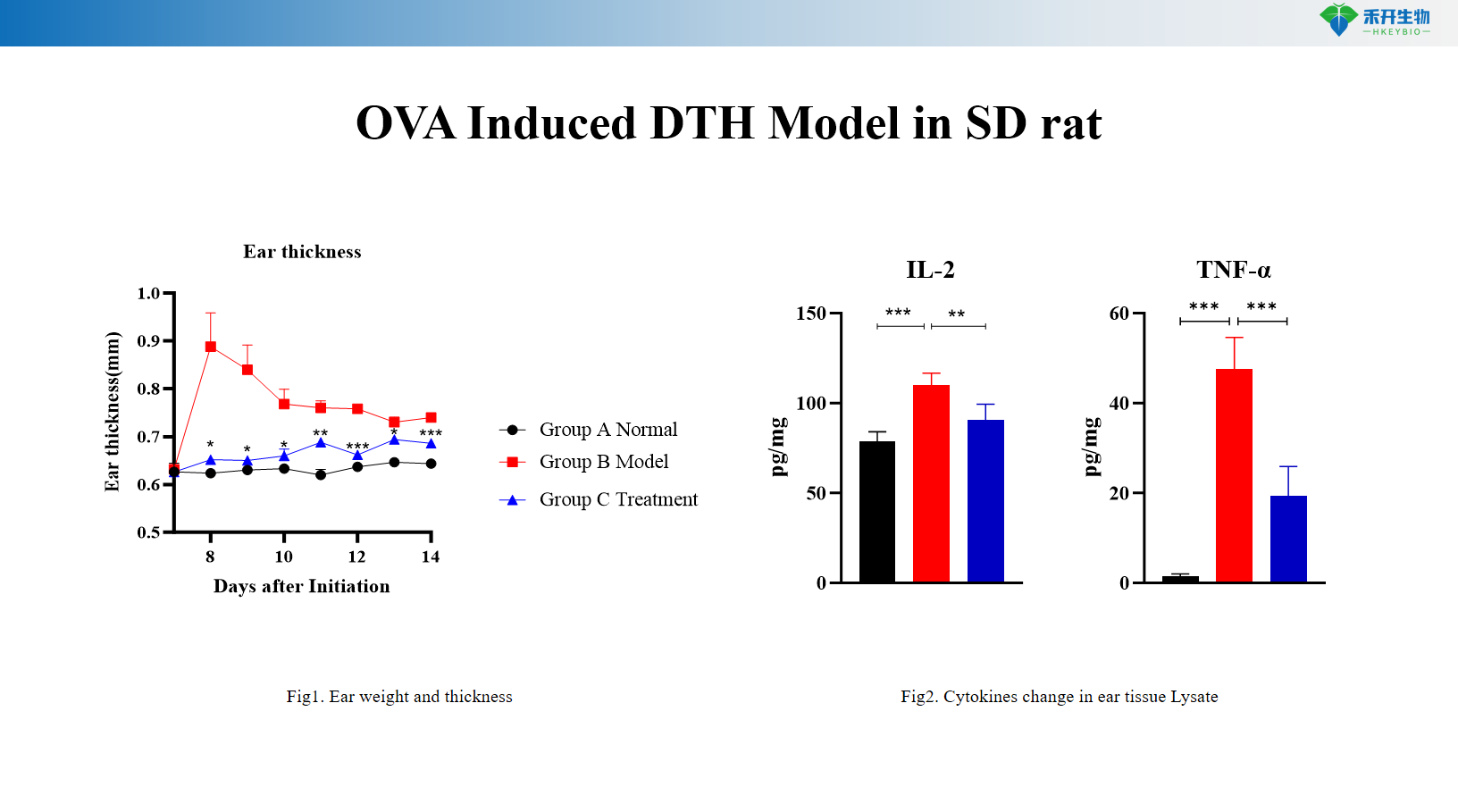
OVA Induced DTH Model in SD rat
Applications
• Efficacy testing of immunosuppressants (corticosteroids, calcineurin inhibitors, methotrexate) for T cell-mediated disorders
• Evaluation of biologics targeting T cell activation, co-stimulation, or Th1/Th17 pathways
• Target validation for cell-mediated immunity and inflammatory responses
• Biomarker discovery (Th1/Th2 cytokine profiles, T cell activation markers)
• IND-enabling pharmacology and toxicology studies
Model Specifications
Parameter | OXA Induced DTH Model (Mouse) | OVA Induced DTH Model (Rat) |
Species/Strain | C57BL/6 mouse | Sprague-Dawley rat |
Sensitization | Oxazolone (OXA) on abdomen (Day 0) | OVA + CFA (Day 0) |
Challenge | OXA on ear (Day 5) | OVA on ear (Day 7) |
Key endpoints | Ear weight and thickness, cytokine levels in ear tissue lysate (IFN-γ, TNF-α, IL-4), optional: histopathology, immune cell infiltration |
Data package | Raw data, analysis reports, behavioral data, histology slides (LFB, IHC), image analysis files, bioinformatics (optional) |
❓ Frequently Asked Questions
Q1: What is Delayed Type Hypersensitivity (DTH) model? What models do you provide? A1: DTH, also known as Type IV hypersensitivity, is a T cell-mediated inflammatory reaction for assessing cell-mediated immunity. We have two mature rodent models: OXA-induced DTH model in C57BL/6 mice and OVA-induced DTH model in SD rats.
Q2: What are the application scenarios of these two DTH models? A2: Both models are widely used to evaluate the efficacy of drugs targeting cellular immunity, immunosuppressants, anti-inflammatory agents and drugs for allergic diseases, and support preclinical research on transplant rejection and infectious diseases related to cellular immunity.
Q3: What evaluation indicators are adopted in the DTH models? A3: The main clinical indicator is ear thickness and ear weight. We also detect the expression levels of key cytokines including IL-4, TNF-α and IFN-γ in ear tissue to comprehensively assess the immune response.
Q4: What is the modeling procedure and key time schedule? A4: For the OXA-induced mouse model: Perform sensitization on Day 0, conduct antigen challenge on Day 5, and evaluate the DTH response 24 hours later. For the OVA-induced rat model: Start sensitization on Day 0, carry out challenge on Day 7, and complete relevant detection within 14 days.
Q5: What are the advantages of your DTH models for preclinical drug research? A5: The models feature stable molding effects and obvious inflammatory reactions. Multiple detection indicators can reflect Th1-type cellular immune responses comprehensively. They are reliable, cost-effective and suitable for high-throughput preclinical efficacy screening and mechanism study of related drugs


