Key Features & Benefits
Clinically relevant – BLM-induced skin fibrosis recapitulates human SSc with dermal thickening, collagen accumulation, and autoantibody production.
Mechanism-driven – BLM induces DNA damage, oxidative stress, and inflammation, leading to fibroblast activation and excessive collagen deposition.
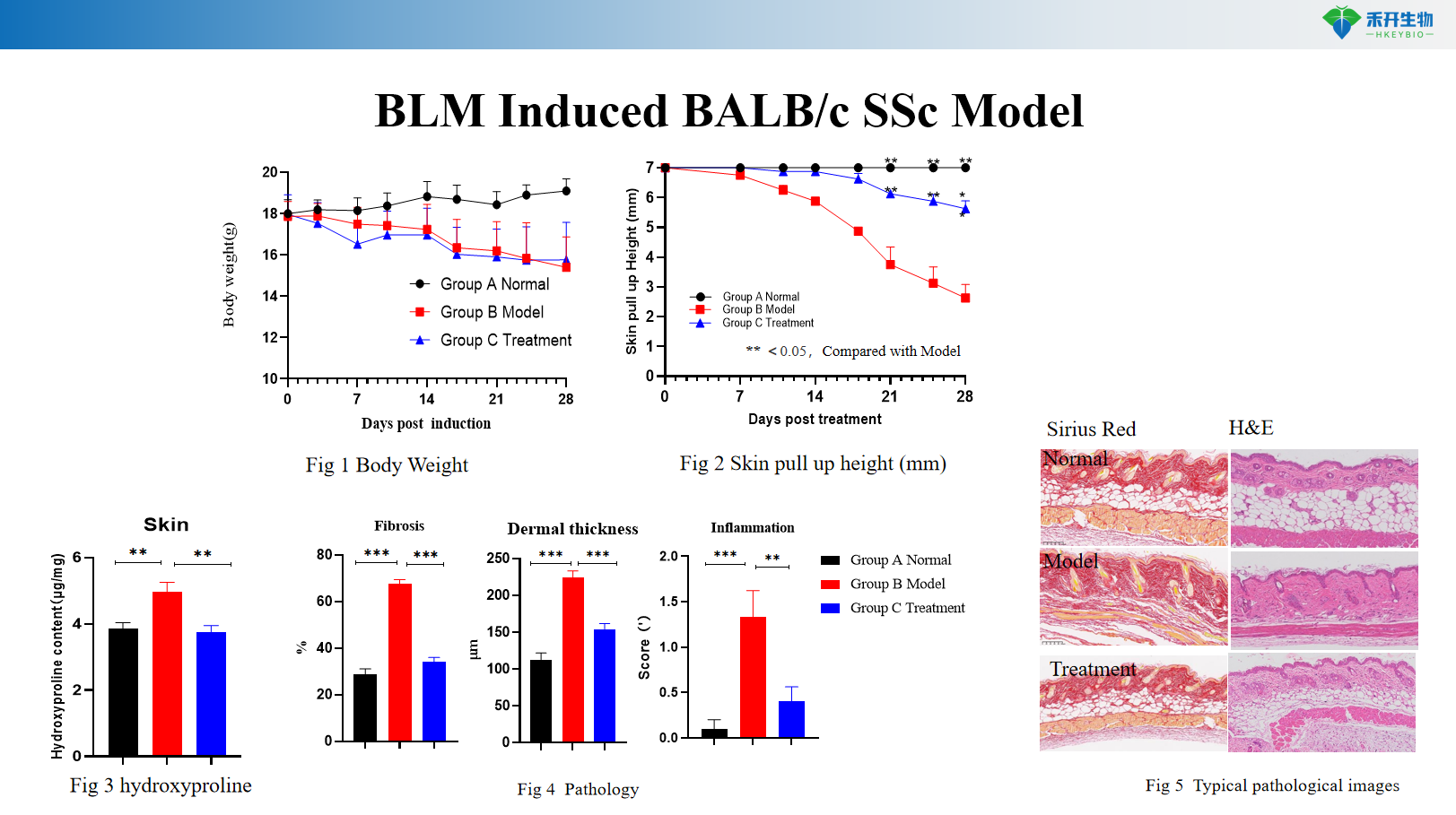
Comprehensive endpoints – Body weight, skin pull-up height (mm), hydroxyproline content (collagen quantification), histopathology (HE, Sirius Red), dermal thickness measurement.
Translational value – Ideal for testing anti-fibrotic agents (nintedanib, pirfenidone), TGF-β inhibitors, tyrosine kinase inhibitors, and immunomodulators.
IND-ready data packages – Studies can be conducted in accordance with GLP principles.
Technical Data & Validation
BLM Induced BALB/c SSc Model
Applications
• Efficacy testing of anti-fibrotic agents (nintedanib, pirfenidone, TGF-β inhibitors, galectin-3 inhibitors)
• Evaluation of tyrosine kinase inhibitors (imatinib, dasatinib) and immunomodulators (corticosteroids, mycophenolate)
• Target validation for fibrosis pathways (collagen synthesis, fibroblast activation)
• Biomarker discovery (hydroxyproline, collagen markers, inflammatory mediators)
• IND-enabling pharmacology and toxicology studies
Model Specifications
Parameter | Specification |
Species/Strain | BALB/c mouse |
Induction method | Intradermal injection of bleomycin (BLM, 50–100 μL of 0.5–1 mg/mL solution) on shaved back skin, 2–3 times/week for 3–6 weeks |
Study duration | 3–8 weeks (induction + treatment phase) |
Key endpoints | Body weight, skin pull-up height (mm) as measure of skin thickness/fibrosis, hydroxyproline content (collagen quantification), skin histopathology (HE and Sirius Red staining with dermal thickness and collagen deposition scoring) |
| Positive control | Nintedanib or pirfenidone available as reference anti-fibrotic compounds |
| Data package | Raw data, analysis reports, histology slides (HE, Sirius Red), hydroxyproline assay results, bioinformatics (optional) |
❓ Frequently Asked Questions
Q1: What rodent systemic sclerosis (SSc) model do you provide, and how is it induced?
A1: We offer a well-characterized bleomycin (BLM)-induced SSc model using BALB/c mice, a classic and widely validated preclinical platform for scleroderma research.Bleomycin is a DNA-damaging copper-chelating peptide. Via daily intradermal administration on dorsal skin, it triggers persistent dermal inflammation, excessive collagen deposition and autoantibody production, closely recapitulating the core pathological features of cutaneous systemic sclerosis in humans.
Q2: What are the advantages of the BALB/c mouse SSc model, and which R&D stages is it most suitable for?
A2: This rodent model is optimized for early-stage drug discovery and high-throughput screening, with distinct value:
High cost efficiency and throughput: It supports parallel testing of multiple drug candidates or dose groups at a lower cost, enabling rapid lead compound screening and ranking.
Stable and reproducible phenotype: The BLM-induced mouse SSc model is a gold-standard platform with well-documented protocols, delivering consistent fibrosis phenotypes for reliable efficacy comparison.
It is ideal for early target validation, preliminary efficacy screening, and mechanism-of-action studies, serving as a cost-effective stepping stone before advancing to NHP translational research.
Q3: What key endpoints are measured in your BLM-induced BALB/c SSc studies?
A3: We provide a comprehensive evaluation system covering functional, biochemical and pathological dimensions:
Clinical & functional endpoints: Longitudinal body weight monitoring for safety assessment, and skin pull-up height measurement to quantify skin sclerosis severity.
Biochemical endpoints: Hydroxyproline content assay in skin tissue for quantitative collagen level detection.
Pathological endpoints: H&E staining for dermal thickness and inflammatory infiltration assessment, and Sirius Red staining for specific collagen fiber visualization and fibrosis grading.
Customized cytokine profiling and autoantibody detection assays are also available upon request.
Q4: What types of therapeutic candidates can be evaluated with this mouse SSc model?
A4: This model supports a broad range of preclinical SSc drug development applications:
Efficacy screening of anti-fibrotic agents targeting collagen synthesis, extracellular matrix remodeling and fibroblast activation.
Evaluation of immunomodulators, anti-inflammatory drugs and cytokine-targeted biologics for autoimmune-mediated fibrosis.
Target validation of fibrotic and autoimmune pathways, and dose-response studies to support lead compound optimization.
Q5: What is the typical study timeline, and do you offer customized protocols and IND-enabling support?
A5: A standard BLM-induced BALB/c SSc efficacy study typically runs 28 days from initial induction to final endpoint assessment.Our scientific team can fully customize study designs including BLM dosage, administration route, treatment regimen and endpoint panels to fit your specific research needs. Studies can also be conducted under GLP principles to deliver regulatory-compliant, audit-ready data packages that support investigational new drug (IND) submissions.


