Main features and benefits
Clinically relevant – Mimics human EGE: weight loss, gastrointestinal eosinophilic infiltration and allergic inflammation.
Well-characterized endpoints – body weight, blood cell counts (WBC, Neu, Eos), tissue eosinophil quantification, intestinal histopathology, OVA-specific antibodies.
Translational Value – Ideal for testing anti-eosinophil therapies (anti-IL-5, anti-IL-5Rα), steroids, and biologics targeting Th2 inflammation.
Mechanistic insights – Ability to study eosinophil recruitment, Th2 cytokine responses, and food allergy mechanisms.
IND Ready Packet – Research can be conducted in accordance with GLP principles.
Technical data and verification
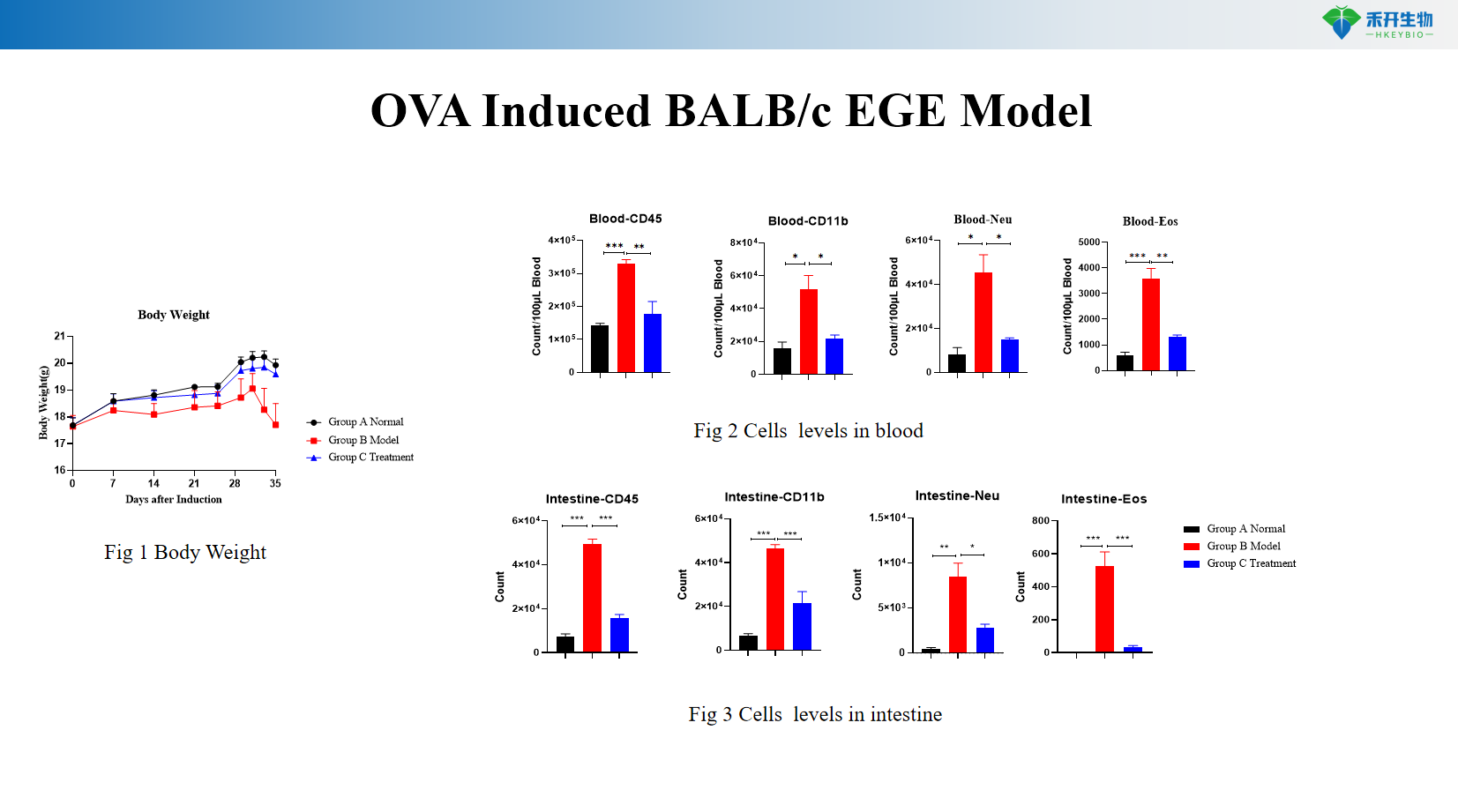
Representative data from our OVA-induced BALB/c EGE model:
OVA induced BALB/c EGE model
Application areas
• Efficacy testing of anti-eosinophil therapies (anti-IL-5, anti-IL-5Rα, anti-Siglec-8), corticosteroids, and biologics targeting Th2 inflammation
• Target validation of eosinophil recruitment and Th2 cytokine pathways
• Food allergy and eosinophilic gastrointestinal disease research
• Mechanism of action (MOA) studies
• Pharmacology and toxicology studies to support IND
Model specifications
scope | Specification |
Species/Strain | BALB/c mouse |
induction method | OVA sensitization (with alum adjuvant, intraperitoneal injection), followed by intragastric OVA challenge |
study time | 4-8 weeks (evaluation of major and minor reactions) |
critical endpoint | Body weight, blood cell count (WBC, Neu, Eos), gastric/intestinal eosinophilic infiltration (histology), OVA-specific IgG/IgE, intestinal histopathology score (villus height, crypt depth, inflammatory infiltrate) |
packet | Raw data, analysis reports, flow cytometry files, bioinformatics (optional) |
❓ FAQ
Question: How does OVA induce EGE in mice?
Answer: Systemic sensitization with OVA plus alum adjuvant induces Th2 immunity. Subsequent intragastric OVA challenge triggers eosinophilic inflammation in the gastrointestinal tract, similar to food antigen-induced EGE.
Q: What are the main similarities to human EGE?
A: This model exhibits weight loss, gastric and intestinal eosinophil infiltration, increased blood eosinophils, and a Th2-related antibody response (OVA-specific IgE) that is very similar to human EGE pathology.
Q: Can this model be used for IND support studies?
Answer: Yes. Studies can be conducted according to GLP principles for regulatory submissions (FDA, EMA).
Q: Do you offer customized study protocols (e.g. different antigens, dosing regimens)?
Answer: Of course. Our scientific team tailors sensitization protocols, challenge plans, and endpoint analyzes for your specific drug candidate.


