Key Features & Benefits
Clinically relevant – Mimics human EGE: weight loss, eosinophilic infiltration in gastrointestinal tract, and allergic inflammation.
Well-characterized endpoints – Body weight, blood cell counts (WBC, Neu, Eos), tissue eosinophil quantification, intestinal histopathology, OVA-specific antibodies.
Translational value – Ideal for testing anti-eosinophil therapies (anti-IL-5, anti-IL-5Rα), steroids, and biologics targeting Th2 inflammation.
Mechanistic insights – Enables study of eosinophil recruitment, Th2 cytokine responses, and food allergy mechanisms.
IND-ready data packages – Studies can be conducted in accordance with GLP principles.
Technical Data & Validation
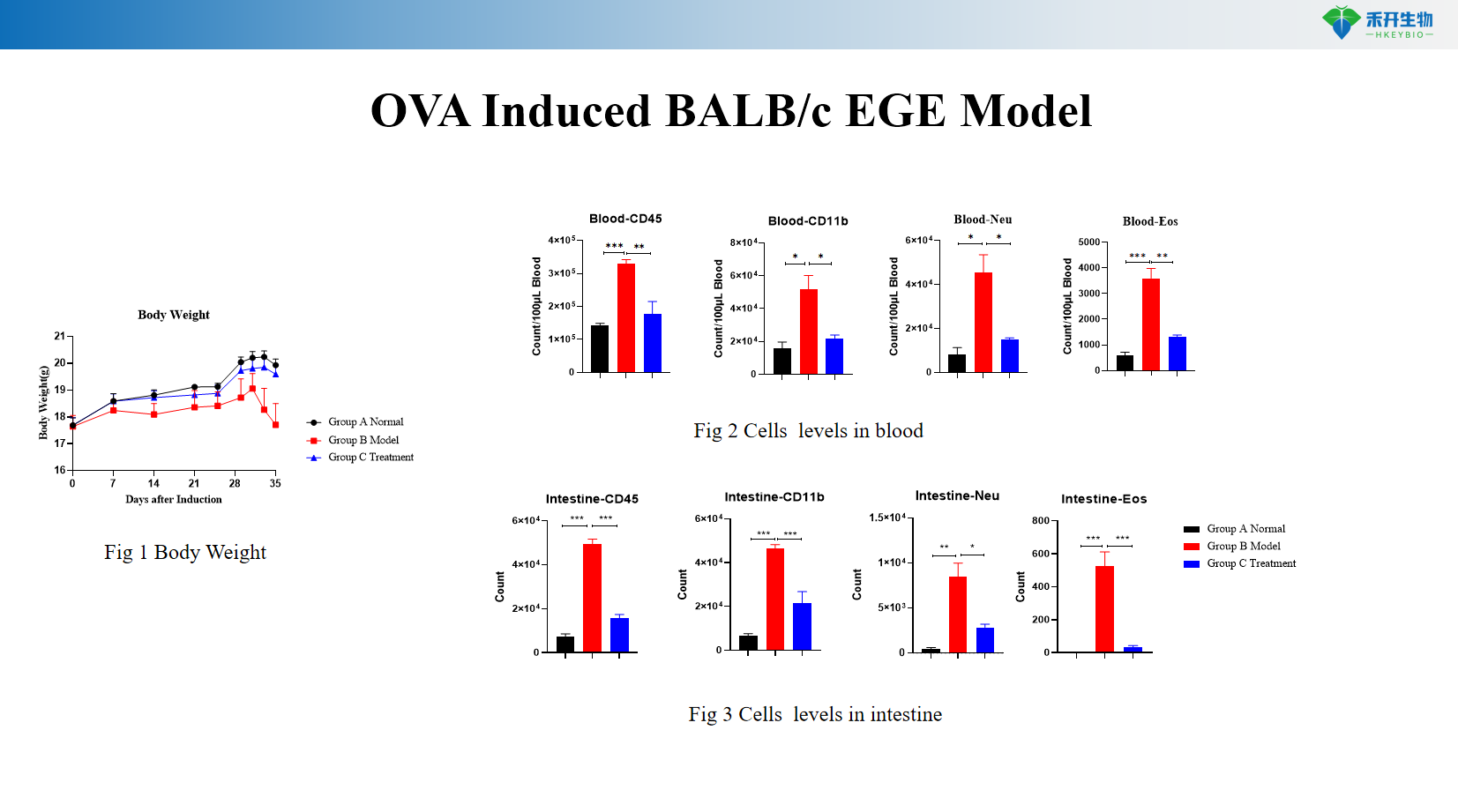
Representative data from our OVA Induced BALB/c EGE model:
OVA Induced BALB/c EGE Model
Applications
• Efficacy testing of anti-eosinophil therapies (anti-IL-5, anti-IL-5Rα, anti-Siglec-8), corticosteroids, and biologics targeting Th2 inflammation
• Target validation for eosinophil recruitment and Th2 cytokine pathways
• Food allergy and eosinophilic gastrointestinal disorder research
• Mechanism of action (MOA) studies
• IND-enabling pharmacology and toxicology studies
Model Specifications
Parameter | Specification |
Species/Strain | BALB/c mouse |
Induction method | OVA sensitization (with alum adjuvant, intraperitoneal) followed by intragastric OVA challenges |
Study duration | 4–8 weeks (primary and secondary response assessment) |
Key endpoints | Body weight, blood cell counts (WBC, Neu, Eos), eosinophil infiltration in stomach/intestine (histology), OVA-specific IgG/IgE, intestinal histopathology score (villus height, crypt depth, inflammatory infiltration) |
Data package | Raw data, analysis reports, flow cytometry files, bioinformatics (optional) |
❓ Frequently Asked Questions
Q1: What EGE preclinical model do you provide? A1: We offer an OVA-induced eosinophilic gastroenteritis model using BALB/c mice for related disease research and drug screening.
Q2: What is the modeling mechanism? A2: OVA sensitization and challenge trigger abnormal Th2 immune responses, causing intestinal and gastric mucosal inflammation as well as massive eosinophil infiltration, which mimics the pathological features of human EGE.
Q3: What evaluation indicators are used? A3: We monitor body weight, perform flow cytometry analysis, detect eosinophils and T cells, and conduct HE staining to assess gastric pathological lesions.
Q4: What is the experimental procedure and cycle? A4: OVA sensitization is carried out from Day 14 to Day 28, followed by OVA challenge every two days. The whole experiment lasts 38 days.
Q5: What are the advantages and applications? A5: This model has stable inflammatory phenotypes and obvious eosinophil infiltration. It is widely applied for efficacy verification and mechanism study of drugs treating eosinophilic gastroenteritis.


