Main features and benefits
Clinical Relevance – Outline human TAO and hyperthyroidism, TSAb production, orbital fibrosis, and ocular pathology.
Mechanism-driven —hTSHR expression induces TSHR autoantibodies, mimicking the autoimmune pathogenesis of human TAO.
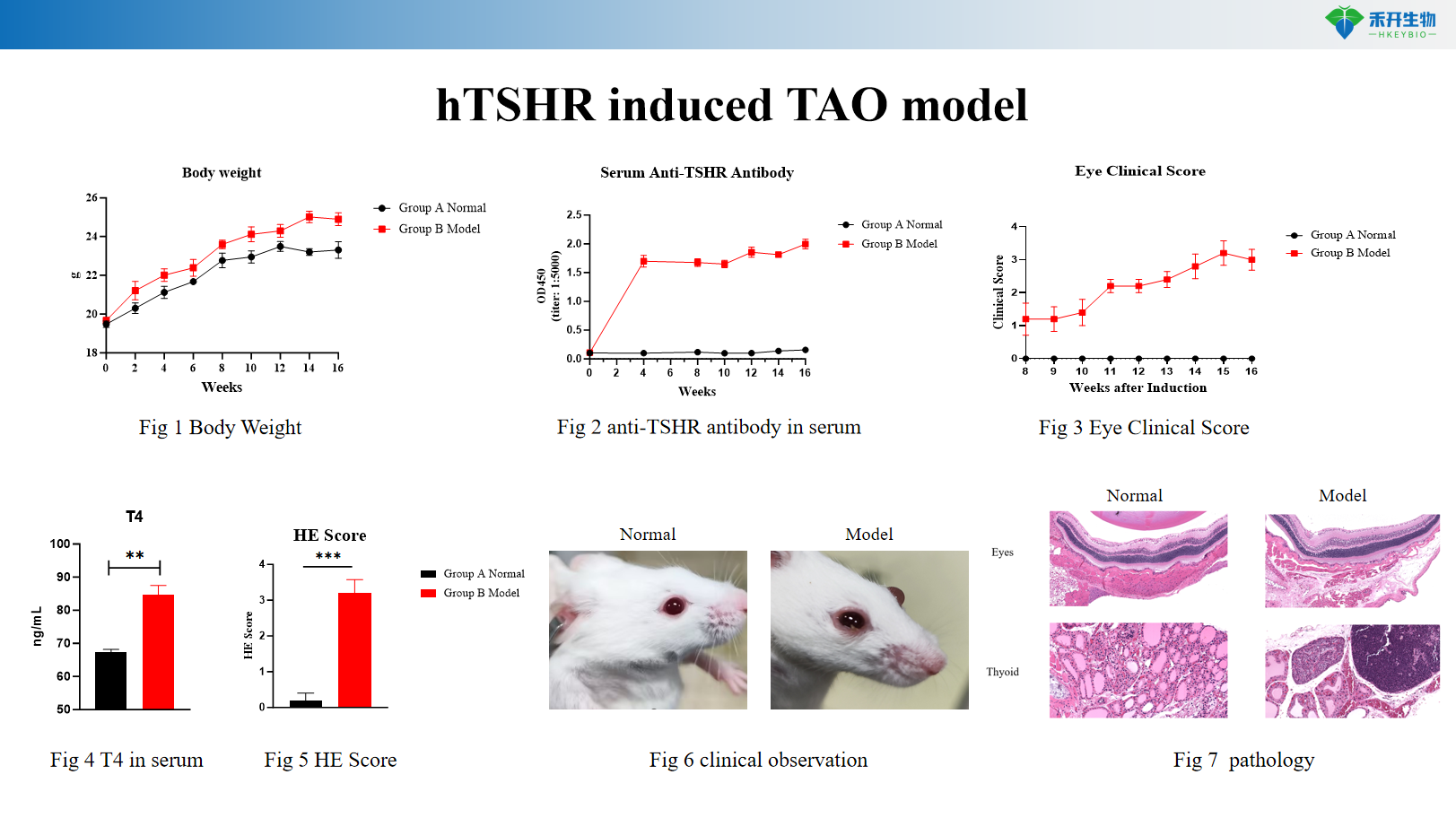
Comprehensive endpoints —body weight, serum T4 and TSAb levels, anti-TSHR antibodies, ocular clinical scores, orbital histopathology (HE), and clinical observations.
Translational Value – Ideal for testing TAO for TSHR antagonists, immunomodulators, and anti-inflammatory therapies.
IND Ready Packet – Research can be conducted in accordance with GLP principles.
Technical data and verification
hTSHR-induced TAO model
Application areas
• Efficacy testing of TSHR antagonists and small molecule inhibitors targeting TSHR signaling
• Evaluation of TAO with immunomodulators (corticosteroids, rituximab, tocilizumab)
• Target validation of TSHR autoimmune and orbital fibrosis pathways
• Biomarker discovery (TSAb, anti-TSHR antibodies, T4 levels)
• Pharmacology and toxicology studies to support IND
Model specifications
scope | Specification |
Species/Strain | BALB/c mouse |
induction method | Human TSHR cDNA is repeatedly electroporated (EP) into skeletal muscle, typically 4-6 times over 8-12 weeks. |
study time | 8–16 weeks (induction + treatment phase) |
critical endpoint | Body weight, serum T4 level (ELISA), serum TSAb (thyroid stimulating antibody), anti-TSHR antibody, ocular clinical score (grade 0-4), orbital histopathology (HE and fibrosis score), clinical observation images |
| positive control | Corticosteroids (e.g. prednisolone) or TSHR antagonists may serve as reference compounds |
packet | Raw data, analysis reports, ELISA results, histological sections, clinical photos, bioinformatics (optional) |
❓ FAQ
Question: How does hTSHR electroporation induce TAO in mice?
Answer: Repeated electroporation of human TSHR cDNA into muscle tissue can drive continued expression of TSHR protein, break immune tolerance and produce TSHR autoantibodies (TSAb). These autoantibodies cross-react with orbital TSHR and induce inflammation, fibrosis, and clinical symptoms of TAO.
Q: What are the main similarities to human TAO?
A: This model exhibits hyperthyroidism (elevated T4), TSAb production, anti-TSHR antibodies, orbital fibrosis, and ocular pathology (eyelid retraction, exophthalmos) that are closely related to human Graves' ophthalmopathy.
Q: Can this model be used for IND support studies?
Answer: Yes. Studies can be conducted according to GLP principles for regulatory submissions (FDA, EMA).
Q: Do you offer customized study protocols (e.g., different electroporation protocols, treatment times)?
Answer: Of course. Our scientific team tailors electroporation protocols, treatment plans, and endpoint analyzes for your specific drug candidate.
Q: What is the typical timeline for a pilot efficacy study?
A: Studies usually last 12-16 weeks, including an 8-12 week induction period and a 4-week endpoint analysis treatment period.


