Key Features & Benefits
Clinically relevant – Recapitulates human AIHA with autoantibody-mediated hemolysis, anemia, and compensatory bone marrow response.
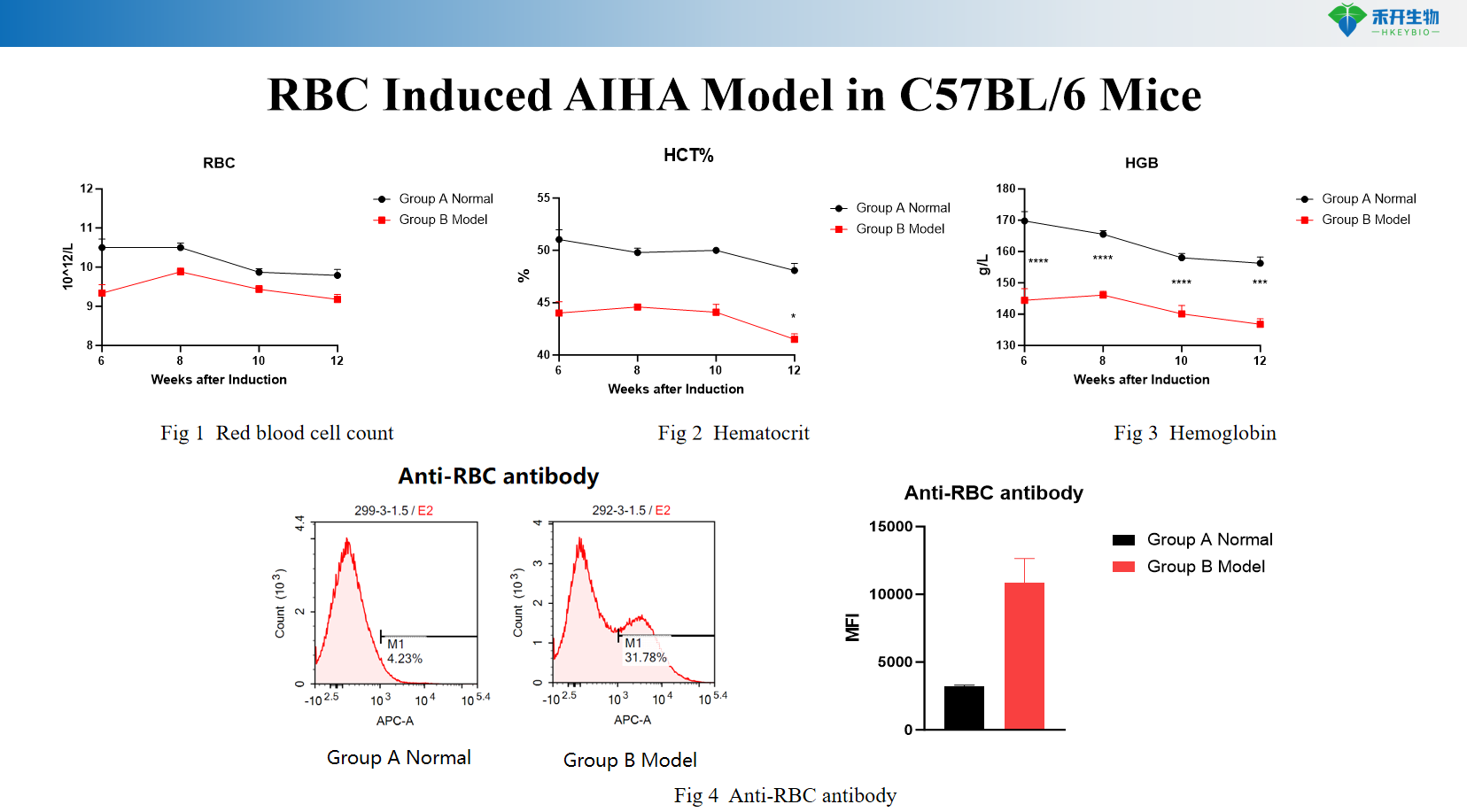
Comprehensive endpoints – RBC count, hematocrit (HCT), hemoglobin (HGB) levels, anti-RBC autoantibody titers (ELISA).
Mechanism-driven – Foreign RBC antigens cross-react with self-erythrocytes, triggering autoantibody production and ADCC-mediated destruction.
Translational value – Ideal for testing immunosuppressants (corticosteroids, cyclophosphamide), B-cell depleting agents (anti-CD20), complement inhibitors (anti-C5), and IVIG.
IND-ready data packages – Studies can be conducted in accordance with GLP principles.
Technical Data & Validation
RBC Induced AIHA Model in C57BL/6 Mice
Applications
• Efficacy testing of immunosuppressants (corticosteroids, cyclophosphamide, mycophenolate, azathioprine)
• Evaluation of B-cell depleting agents (anti-CD20, anti-CD19) and plasma cell targeting therapies
• Testing of complement inhibitors (anti-C5, C5aR antagonists) and FcRn blockers
• Target validation for autoantibody-mediated hemolysis pathways
• IND-enabling pharmacology and toxicology studies
Model Specifications
Parameter | Specification |
Species/Strain | C57BL/6 mouse |
Induction method | Intraperitoneal injection of rat RBCs (2 × 10⁸ cells), twice weekly for 8–12 weeks |
Study duration | 8–14 weeks (induction + treatment phase) |
Key endpoints | Red blood cell count (RBC), hematocrit (HCT), hemoglobin (HGB), anti-RBC autoantibody titers (ELISA), optional: reticulocyte count, spleen weight, bone marrow analysis, direct Coombs test, complement deposition (C3), cytokine profiling |
Data package | Raw data, analysis reports, hematology analyzer outputs, ELISA results, histology slides (spleen, bone marrow), bioinformatics (optional) |
❓ Frequently Asked Questions
Q1: What AIHA preclinical model do you provide? A1: We offer a mature red blood cell (RBC)-induced AIHA model using C57BL/6 mice for autoimmune hemolytic anemia research and drug evaluation.
Q2: What is the modeling mechanism? A2: Repeated RBC injection induces cross-reactive autoantibodies against self erythrocytes. It triggers antibody-mediated red blood cell destruction, which replicates the core pathogenesis of human AIHA.
Q3: What evaluation indicators are used? A3: We detect red blood cell count, hematocrit and hemoglobin levels. We also test anti-RBC autoantibody to assess the severity of hemolytic anemia.
Q4: What is the experimental schedule? A4: RBC is injected twice a week for 8 weeks starting from Week 0. All sample collection and detection are completed at Week 12.
Q5: What are the advantages and applications? A5: This model has stable hemolytic symptoms and reliable repeatability. It is widely used for efficacy screening and mechanism study of drugs for autoimmune hemolytic anemia.


