Key Features & Benefits
Clinically relevant – Recapitulates human vitiligo: CD8+ T cell mediated melanocyte destruction, progressive depigmentation, and skin pathology.
Immunological mechanism – Autoreactive CD8+ T cell activation against melanocyte antigens, with CD4+ Treg depletion.
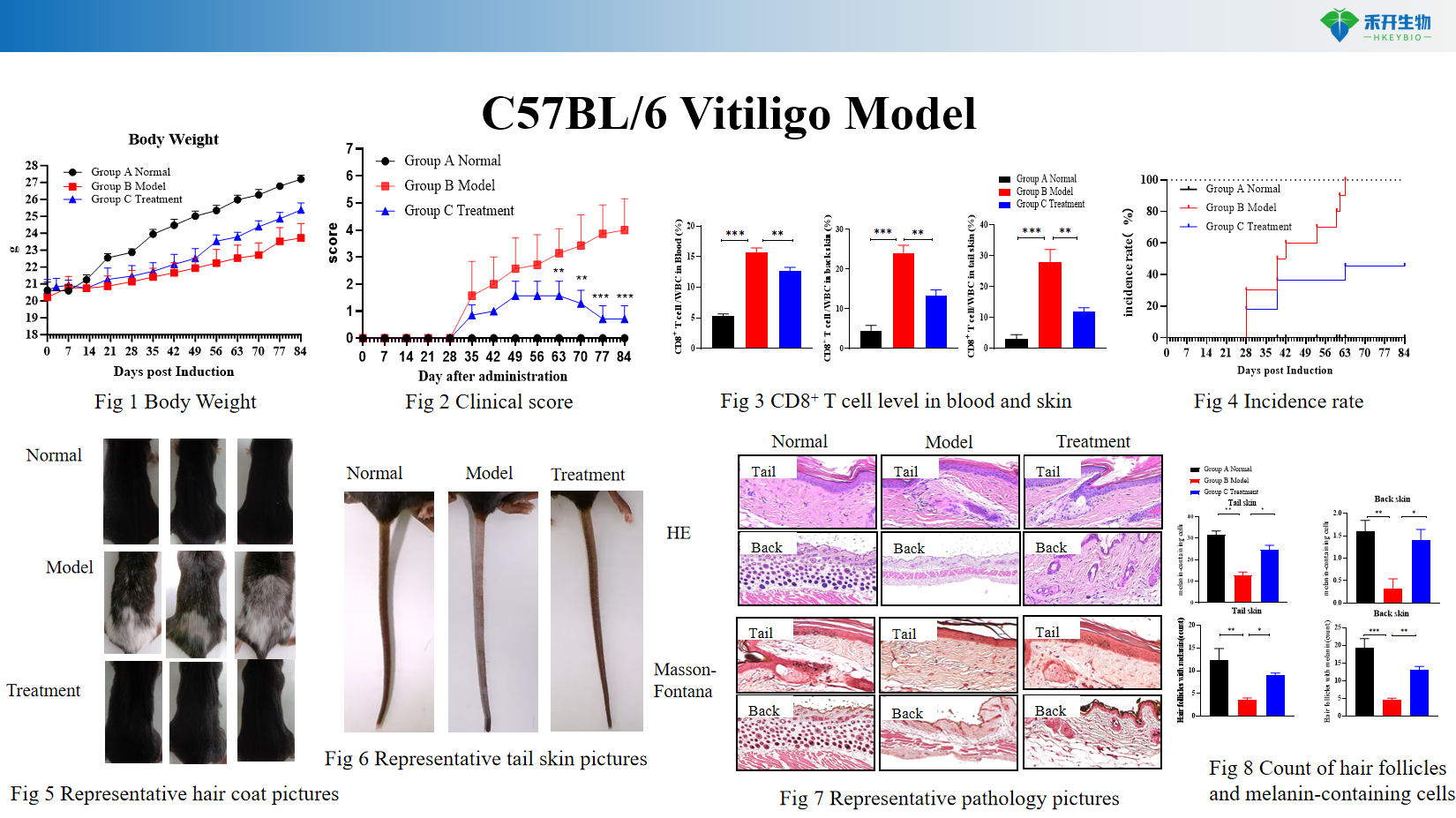
Comprehensive endpoints – Body weight, spleen index, clinical score, CD8+ T cell levels in blood and skin, incidence rate, hair coat and tail skin pictures, histopathology, melanin-containing cell counts.
Translational value – Ideal for testing JAK inhibitors, topical immunomodulators, and biologics targeting T cell responses.
IND-ready data packages – Studies can be conducted in accordance with GLP principles.
Technical Data & Validation
C57BL/6 Vitiligo Model
Applications
• Efficacy testing of JAK inhibitors (ruxolitinib, tofacitinib), topical immunomodulators, and biologics targeting CD8+ T cells
• Target validation for melanocyte-specific immune pathways
• Biomarker discovery (CD8+ T cell markers, melanocyte antigens)
• Mechanism of action (MOA) studies for autoimmune skin disorders
• IND-enabling pharmacology studies
Model Specifications
Parameter | Specificatio |
Species/Strain | C57BL/6 mouse |
Induction method | Subcutaneous inoculation of B16F10 melanoma cells + CD4+ T cell depletion (anti-CD4 antibody) |
Study duration | 4–8 weeks |
Key endpoints | Body weight, spleen index, clinical score, CD8+ T cell levels in blood and skin (flow cytometry), incidence rate, hair and tail skin depigmentation scoring, skin histopathology (H&E, melanocyte staining), melanin-containing cell counts |
Data package | Raw data, analysis reports, flow cytometry files, clinical photographs, histology slides, bioinformatics (optional)Raw data, analysis reports, glucose curves, histology slides, bioinformatics (optional) |
❓ Frequently Asked Questions
Q2: What is the modeling mechanism? A2: The model is established via B16F10 cell inoculation and CD4+ regulatory T cell depletion. It activates autoreactive CD8+ T cells to attack epidermal melanocytes, fully recapitulating the pathological features of human vitiligo.
Q3: What evaluation indicators are used? A3: We monitor body weight and spleen index clinically, detect CD8+ T cell levels in blood and skin, and perform skin histopathological analysis.


