Main features and benefits
Clinical Relevance - Overview of human AIHA and autoantibody-mediated hemolysis, anemia, and compensatory bone marrow responses.
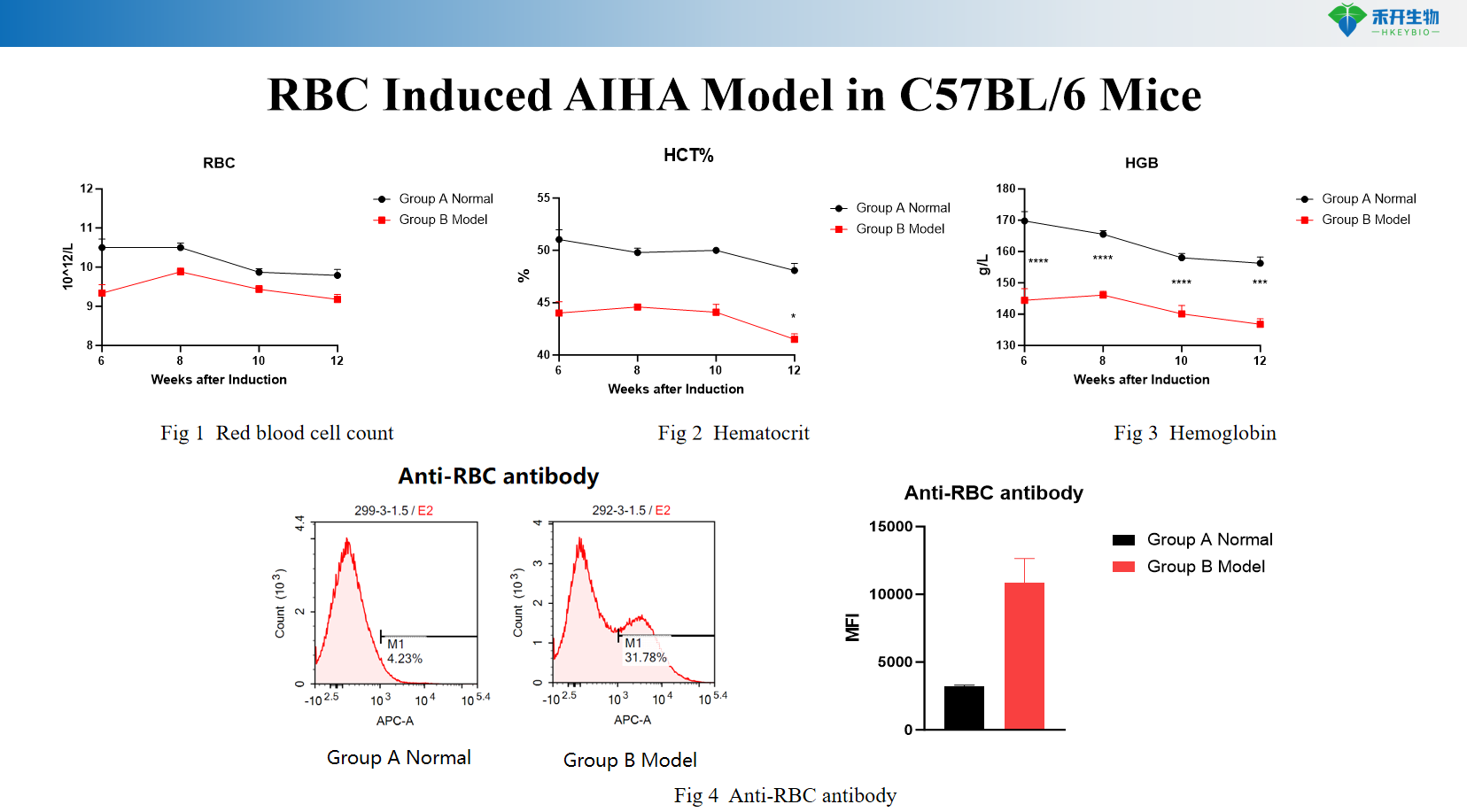
Composite endpoint – red blood cell count, hematocrit (HCT), hemoglobin (HGB) level, anti-erythrocyte autoantibody titer (ELISA).
Mechanism-driven —Exogenous red blood cell antigens cross-react with autologous red blood cells, triggering autoantibody production and ADCC-mediated destruction.
Translational value – ideal for testing immunosuppressants (corticosteroids, cyclophosphamide), B-cell depleting agents (anti-CD20), complement inhibitors (anti-C5) and IVIG.
IND Ready Packet – Research can be conducted in accordance with GLP principles.
Technical data and verification
RBC induces AIHA model in C57BL/6 mice
Application areas
• Efficacy testing of immunosuppressants (corticosteroids, cyclophosphamide, mycophenolate mofetil, azathioprine)
• Evaluation of B-cell depleting agents (anti-CD20, anti-CD19) and plasma cell-targeted therapies
• Testing of complement inhibitors (anti-C5, C5aR antagonists) and FcRn blockers
• Target validation of autoantibody-mediated hemolytic pathways
• Pharmacology and toxicology studies to support IND
Model specifications
scope | Specification |
Species/Strain | C57BL/6 mouse |
induction method | Intraperitoneal injection of rat red blood cells (2 × 10⁸ cells) twice weekly for 8-12 weeks |
study time | 8–14 weeks (induction + treatment phase) |
critical endpoint | Red blood cell count (RBC), hematocrit (HCT), hemoglobin (HGB), anti-erythrocyte autoantibody titer (ELISA), optional: reticulocyte count, spleen weight, bone marrow analysis, direct Coombs test, complement deposition (C3), cytokine analysis |
packet | Raw data, analysis report, hematology analyzer output, ELISA results, histology sections (spleen, bone marrow), bioinformatics (optional) |
❓ FAQ
Question: How does RBC immunization induce AIHA in mice?
Answer: Repeated immunization with exogenous (rat) red blood cells elicits an immune response against red blood cell antigens. Some of these antibodies cross-react with mouse erythrocyte antigens, leading to the production of autoantibodies and subsequent hemolysis through ADCC, complement activation, and phagocytosis.
Q: What are the main similarities to human AIHA?
A: This model exhibits anemia (decreased RBC, HCT, HGB), elevated anti-RBC autoantibodies (positive Coombs test), and evidence of immune-mediated hemolysis, very similar to human thermal AIHA.
Q: Can this model be used for IND support studies?
Answer: Yes. Studies can be conducted according to GLP principles for regulatory submissions (FDA, EMA).
Q: Do you offer customized study protocols (e.g., different red blood cell sources, immunization schedules)?
Answer: Of course. Our scientific team tailors induction protocols, treatment plans and endpoint analyzes for your specific drug candidate.


