Main features and benefits
Clinical Relevance – Overview of human AAV and MPO-ANCA pathogenesis, crescentic glomerulonephritis, and renal dysfunction.
Mechanistically driven – Combining MPO sensitization with glomerular MPO deposition via anti-GBM antibodies triggers neutrophil activation and crescent formation.
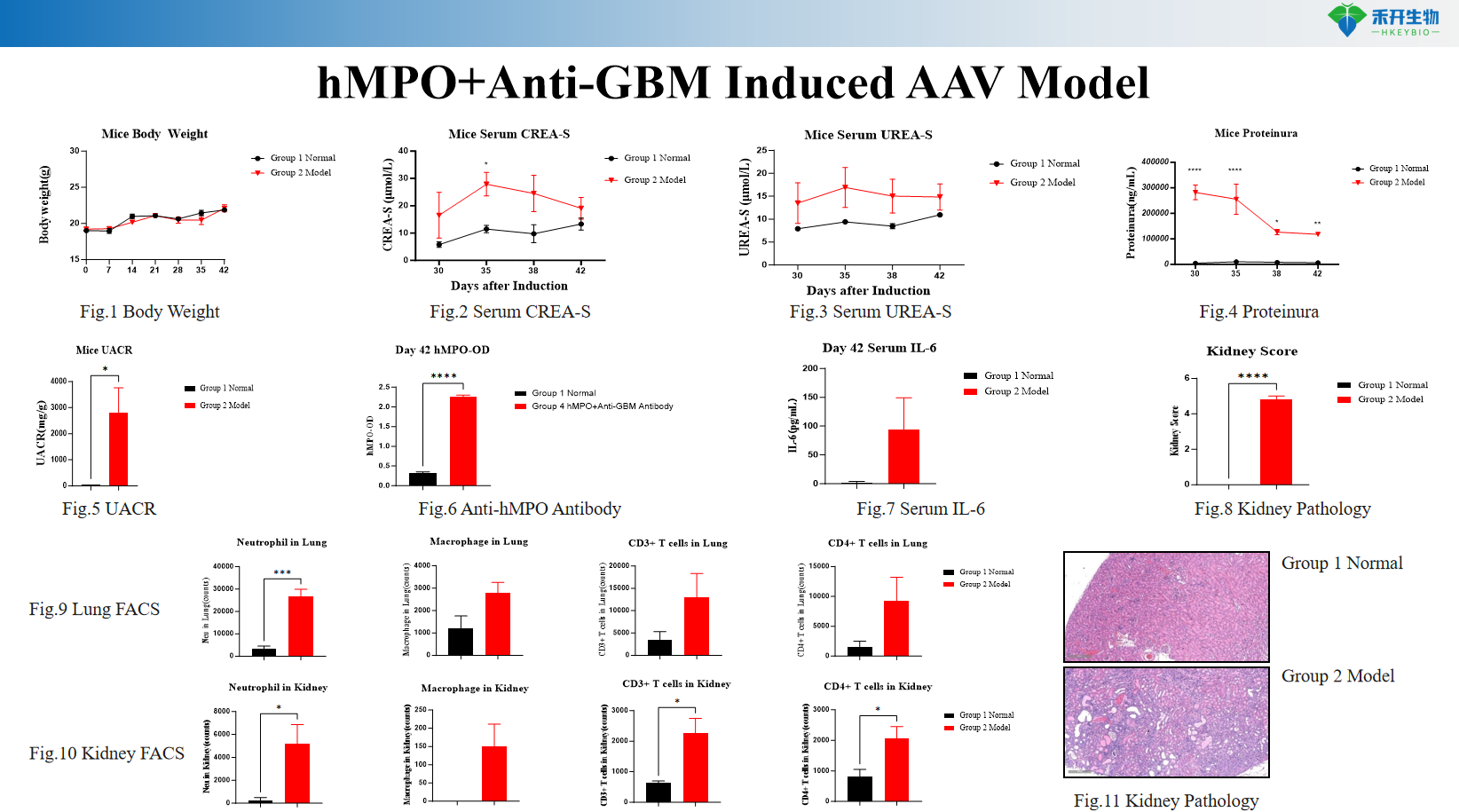
Composite endpoint – body weight, UACR, proteinuria, serum CREA/UREA, IL-6 levels, renal histopathology (HE), FACS/IHC immune cell infiltration (neutrophils, macrophages, T cells).
Translational Value – Ideal for testing complement inhibitors (anti-C5), neutrophil modulators, immunosuppressants, and biologics targeting the B-cell/T-cell pathway.
IND Ready Packet – Research can be conducted in accordance with GLP principles.
Technical data and verification
hMPO+anti-GBM-induced AAV model
Application areas
• Efficacy testing of complement inhibitors (anti-C5, C5aR antagonists), neutrophil elastase inhibitors, immunosuppressants (cyclophosphamide, rituximab) and biologics targeting the B-cell/T-cell pathway
• Target validation of neutrophil activation, NETosis and complement pathways
• Biomarker discovery (MPO-ANCA, cytokines, urine markers)
• Mechanism of action (MOA) research on autoimmune vasculitis
• Pharmacology and toxicology studies to support IND
Model specifications
scope | Specification |
Species/Strain | C57BL/6 mouse |
induction method | Immunization with human MPO (hMPO) in complete Freund's adjuvant (CFA) followed by subnephrogenic doses of anti-glomerular basement membrane (anti-GBM) antibody(iv) |
study time | 4–6 weeks (sensitization + challenge) |
critical endpoint | Body weight, urine albumin to creatinine ratio (UACR), proteinuria, serum CREA/UREA, IL-6 levels (ELISA), renal histopathology (HE staining for crescentic glomerulonephritis), immune cell infiltration (neutrophils, macrophages, CD4+ T cells) by FACS or IHC, optional: MPO-ANCA titer |
packet | Raw data, analytical reports, clinical chemistry, urinalysis, histology slides (HE), FACS files, bioinformatics (optional) |
❓ FAQ
Q: How does the hMPO+Anti-GBM model induce AAV?
Answer: Mice are first sensitive to human MPO and develop an MPO-specific immune response. Sub-nephrogenic doses of anti-GBM antibodies then target the glomerular basement membrane, depositing MPO in the glomerulus. This triggers MPO-ANCA-mediated neutrophil activation, crescentic glomerulonephritis, and renal injury.
Q: What are the main similarities to human AAV?
A: This model exhibits crescentic glomerulonephritis, proteinuria, renal dysfunction (elevated CREA/UREA), neutrophil and macrophage infiltration, and elevated IL-6, closely related to human MPO-ANCA-associated vasculitis.
Q: Can this model be used for IND support studies?
Answer: Yes. Studies can be conducted according to GLP principles for regulatory submissions (FDA, EMA).
Q: Do you offer customized study protocols (eg, different MPO sources, anti-GBM doses)?
Answer: Of course. Our scientific team tailors induction protocols, treatment plans and endpoint analyzes for your specific drug candidate.


