Main features and benefits
Clinical relevance – Overview of human vitiligo: CD8+ T cell-mediated melanocyte destruction, progressive depigmentation, and skin pathology.
Immunological mechanism – Activation of autoreactive CD8+ T cells against melanocytic antigens with concomitant CD4+ Treg depletion.
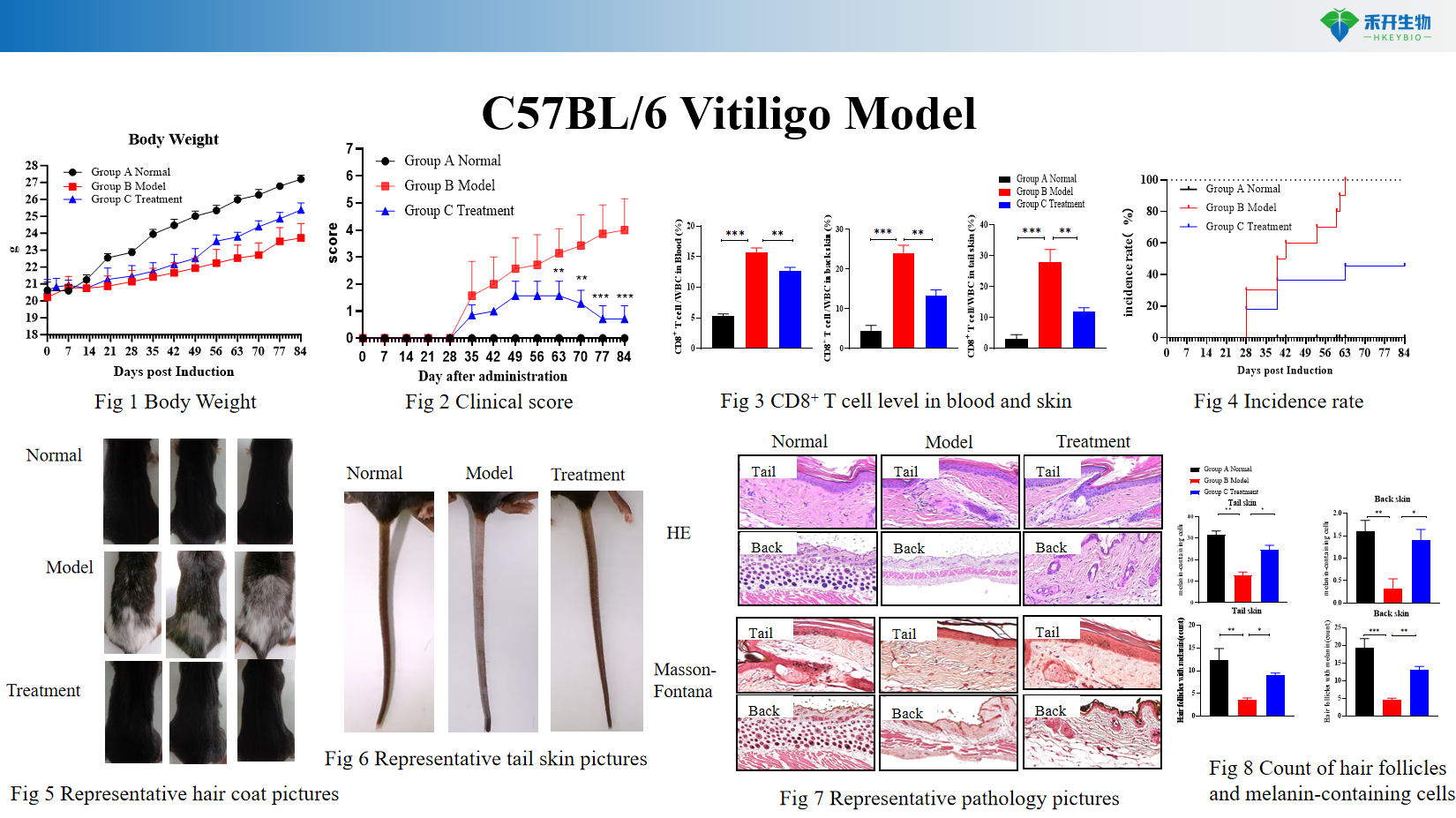
Composite endpoints —body weight, spleen index, clinical score, CD8+ T cell levels in blood and skin, morbidity, fur and tail skin images, histopathology, melanocyte-containing cell count.
Translational Value – Ideal for testing JAK inhibitors, topical immunomodulators, and biologics targeting T cell responses.
IND Ready Packet – Research can be conducted in accordance with GLP principles.
Technical data and verification
C57BL/6 vitiligo model
Application areas
• Efficacy testing of JAK inhibitors (ruxolitinib, tofacitinib), topical immunomodulators, and biologics targeting CD8+ T cells
• Target validation of melanocyte-specific immune pathways
• Biomarker discovery (CD8+ T cell markers, melanocyte antigen)
• Mechanism of action (MOA) research on autoimmune dermatoses
• Pharmacological studies to support IND
Model specifications
scope | Specification |
Species/Strain | C57BL/6 mouse |
induction method | Subcutaneous B16F10 melanoma cell + CD4+ T cell depletion (anti-CD4 antibody) |
study time | 4-8 weeks |
critical endpoint | Body weight, spleen index, clinical score, CD8+ T cell levels in blood and skin (flow cytometry), morbidity, hair and tail skin depigmentation score, skin histopathology (H&E, melanocyte stain), melanocyte count |
packet | Raw data, analysis reports, flow cytometry files, clinical photos, histology slides, bioinformatics (optional) Raw data, analysis reports, blood glucose curves, histology slides, bioinformatics (optional) |
❓ FAQ
Question: How does B16F10 cell inoculation induce vitiligo?
Answer: B16F10 melanoma cells express melanocyte differentiation antigen. Transient vaccination activates autoreactive CD8+ T cells that, in the absence of CD4+ Tregs, target and destroy epidermal melanocytes, leading to progressive depigmentation.
Q: What are the main similarities to human vitiligo?
A: This model exhibits CD8+ T cell infiltration in the skin, progressive depigmentation (hair and skin), melanocyte loss, and the same histopathological changes as human vitiligo.
Q: Can this model be used for IND support studies?
Answer: Yes. Studies can be conducted according to GLP principles for regulatory submissions (FDA, EMA).
Q: Do you offer customized study protocols (e.g., different B16F10 doses, timing of Treg depletion)?
Answer: Of course. Our scientific team tailors induction protocols, treatment plans and endpoint analyzes for your specific drug candidate.


