Key Features & Benefits
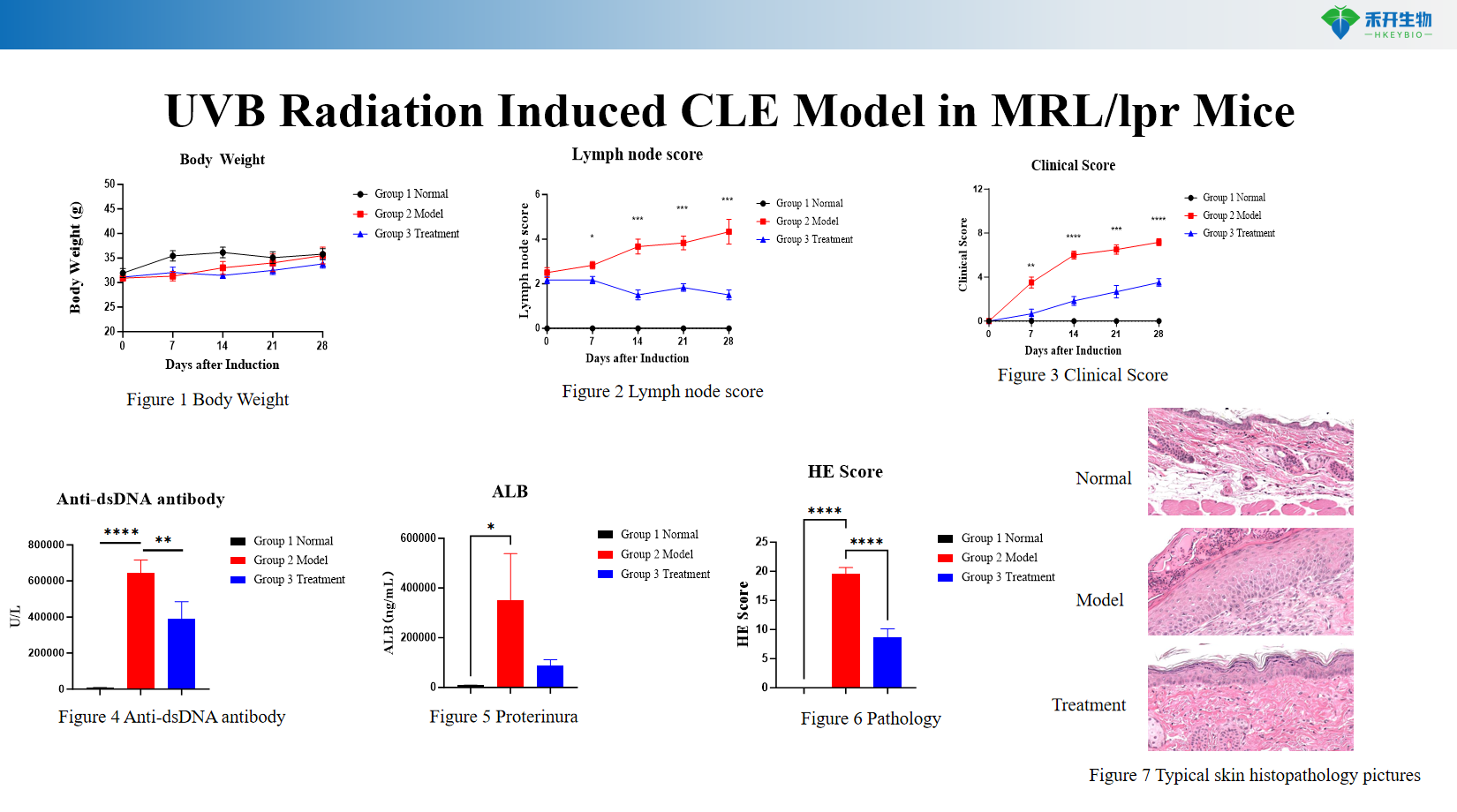
Clinically relevant – UVB exposure in lupus-prone mice mimics photosensitive CLE, including skin lesions and systemic autoimmunity.
Comprehensive endpoints Translational value Technical Data & Validation
Technical Data & Validation
UVB Radiation Induced CLE Model in MRL/lpr Mice
Applications
• Efficacy testing of topical and systemic immunomodulators (corticosteroids, calcineurin inhibitors, JAK inhibitors)
• Evaluation of antimalarials (hydroxychloroquine) and biologics targeting type I interferons (anifrolumab) or B cells (rituximab)
• Target validation for photosensitivity and autoimmune pathways in CLE
• Biomarker discovery (anti-dsDNA, interferon-stimulated genes)
• IND-enabling pharmacology and toxicology studies
Model Specifications
Parameter | Specification |
Species/Strain | MRL/lpr mouse |
Induction method | Repeated UVB irradiation (312 nm, 100–200 mJ/cm²) on shaved dorsal skin, 3–5 times/week for 2–4 weeks |
Study duration | 3–6 weeks (irradiation + treatment phase) |
Key endpoints | Body weight, clinical skin score (erythema, scaling, excoriation), lymph node score, serum anti-dsDNA antibodies (ELISA), skin histopathology (HE with interface dermatitis scoring), optional: kidney histopathology, type I interferon signature, immunofluorescence for immune complex deposition |
Data package | Raw data, analysis reports, clinical scores, histology slides (skin, kidney), ELISA results, bioinformatics (optional) |
❓ Frequently Asked Questions
Q1: Why choose the UVB-induced MRL/lpr model over conventional spontaneous lupus models for CLE research?
A1:Unlike spontaneous lupus models that develop systemic disease slowly, this UVB-driven model is purpose-built for photosensitive CLE studies, with two core unique advantages:
Clinically relevant pathogenesis: It mimics the real-world scenario where UV exposure triggers CLE flares in patients. Repeated 312 nm UVB irradiation on dorsal skin induces keratinocyte damage, autoantigen release, and localized interface dermatitis, highly consistent with human CLE pathology.
Dual phenotype coverage: Built on the lupus-prone MRL/lpr background, it presents both typical cutaneous lesions and systemic autoimmune manifestations (elevated anti-dsDNA antibodies, renal involvement potential), making it suitable for evaluating drugs that target both skin and systemic lupus.
Q2: Beyond skin lesion assessment, what systemic lupus-related endpoints can be evaluated in this CLE model?
A2:We provide a full-spectrum evaluation system covering skin, systemic immunity and organ involvement, which goes beyond simple dermatitis models:
Cutaneous endpoints: Clinical skin scoring (erythema, scaling, excoriation) and histopathological scoring for interface dermatitis via H&E staining;
Systemic immune endpoints: Serum anti-dsDNA antibody quantification by ELISA, lymph node index assessment, and optional type I interferon signature detection;
Organ involvement endpoints: Optional renal histopathology and immunofluorescence staining for immune complex deposition, to support evaluation of drugs for progressive lupus with systemic involvement.
Q3: What types of anti-lupus therapeutics are suitable for efficacy evaluation with this model?
A3:This model supports efficacy assessment across multiple therapeutic modalities for CLE and systemic lupus, covering both topical and systemic regimens:
Topical agents: Corticosteroids, calcineurin inhibitors and topical JAK inhibitors for skin lesions;
Standard systemic therapies: Antimalarials such as hydroxychloroquine, the first-line treatment for CLE;
Innovative biologics: Type I interferon-targeting agents (e.g., anifrolumab), B-cell depletion therapies (e.g., rituximab) and other novel immunomodulators;
Small molecule candidates: JAK inhibitors, TYK2 modulators and other targeted oral drugs.
Q4: Can data from this CLE model support IND submissions, and can UVB irradiation protocols be customized?
Regulatory compliance: Studies can be conducted in accordance with GLP principles, and we deliver full audit-ready data packages that meet FDA, EMA and NMPA requirements for IND-enabling pharmacology studies.
Flexible customization: Our scientific team can tailor UVB parameters (dose intensity, irradiation frequency, course duration) and treatment regimens (administration route, dose gradient, dosing schedule) based on your drug’s mechanism of action and research objectives.
Q5: What is the typical study timeline, and how stable is the disease phenotype of this model?
A5:A standard efficacy study typically runs 3–6 weeks, including 2–4 weeks of UVB induction (3–5 times per week) plus a parallel or sequential treatment phase. This model has been rigorously validated internally with high phenotypic stability: skin lesions appear consistently after 1–2 weeks of UVB exposure, and autoantibody levels and histopathological features show low inter-animal and inter-batch variation, ensuring reliable and reproducible efficacy evaluation results.


