Key Features & Benefits
Clinically relevant – Two complementary models cover different itch etiologies: mechanical damage (wound healing) and IL-31 mediated (inflammatory/neurogenic).
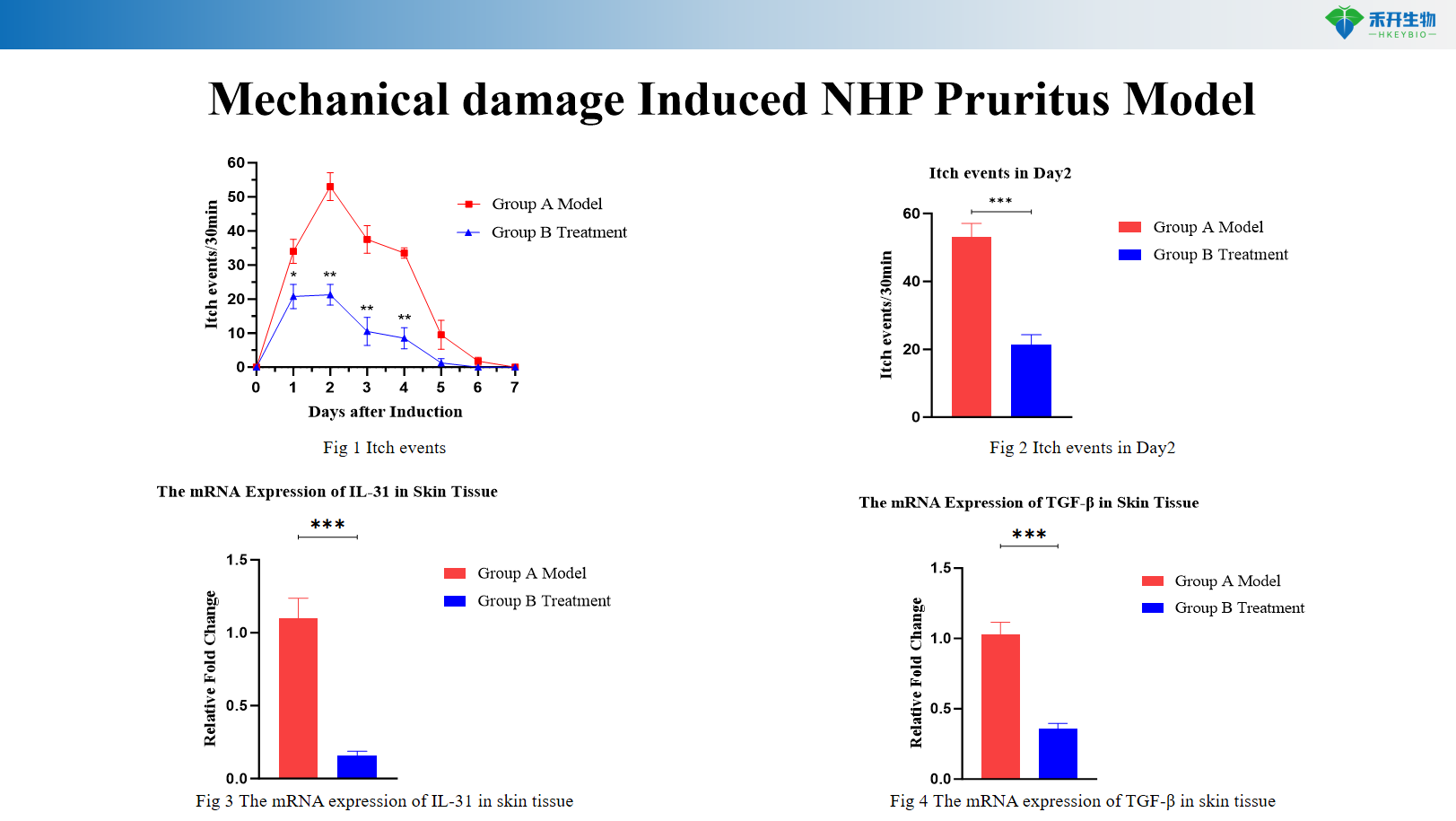
Quantifiable endpoints – Itch events (scratching behavior) as primary endpoint; molecular markers (IL-31, TGF-β mRNA) for mechanistic insights.
Translational value – NHP models offer high genetic and physiological similarity to humans, ideal for testing anti-itch drugs (anti-IL-31, JAK inhibitors, TRP channel modulators).
Multi-mechanism coverage – Mechanical model captures wound healing-associated itch; IL-31 model captures inflammatory/neurogenic itch.
IND-ready data packages – Studies can be conducted in accordance with GLP principles.
Technical Data & Validation
Mechanical damage Induced NHP Pruritus Model
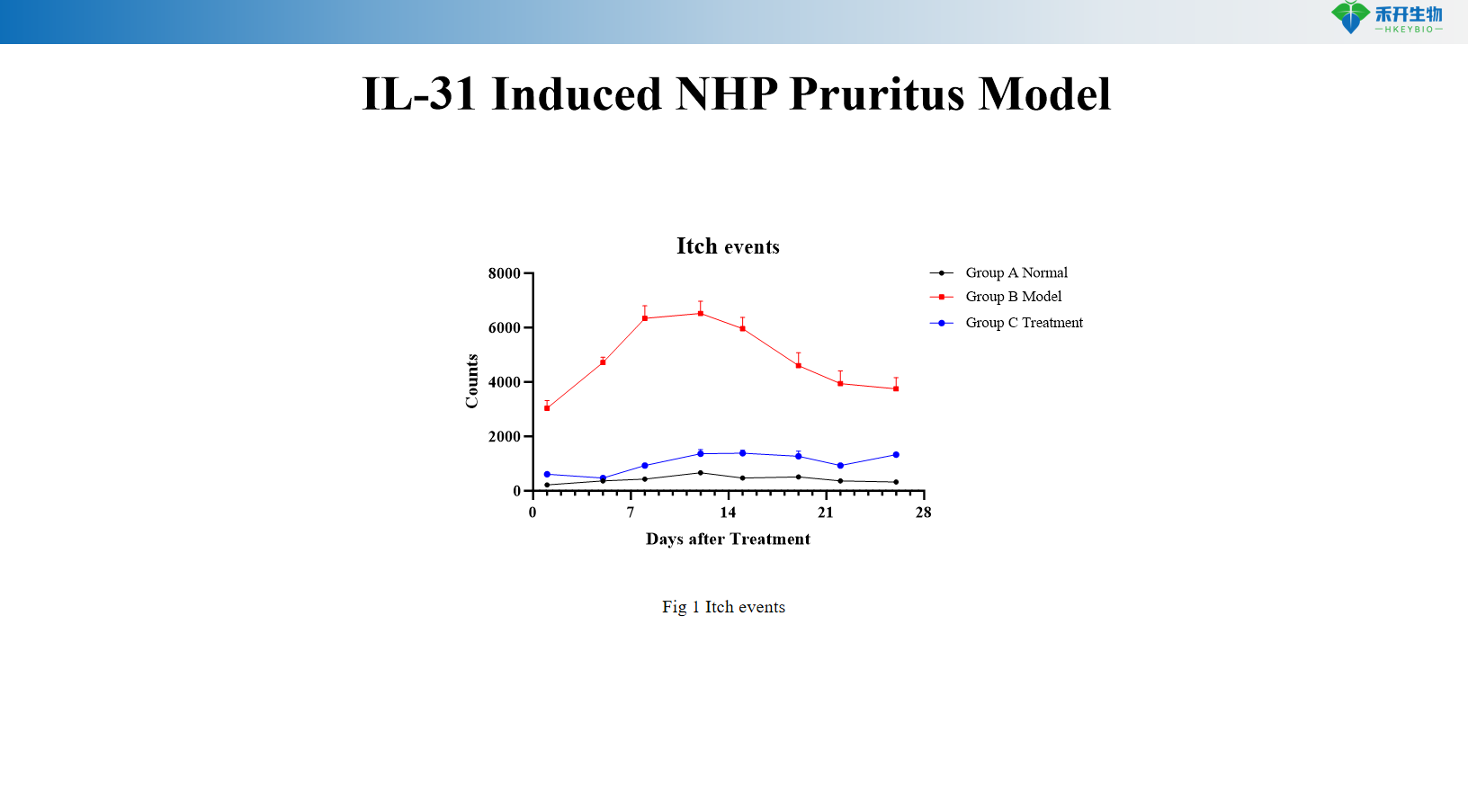
IL-31 Induced NHP Pruritus Model
Applications
• Efficacy testing of anti-pruritic drugs (anti-IL-31 antibodies, JAK inhibitors, TRPV1 antagonists, opioid receptor modulators)
• Target validation for IL-31 and downstream signaling pathways
• Mechanism of action studies for chronic itch
• Biomarker discovery (IL-31, TGF-β, other itch-related mediators)
• IND-enabling safety pharmacology studies for compounds with potential pruritic side effects
Model Specifications
Parameter | Mechanical Damage Induced Model | IL-31 Induced Model |
Species | Cynomolgus macaque (Macaca fascicularis) | Cynomolgus macaque (Macaca fascicularis) |
Induction method | Cutaneous mechanical injury (skin wounding) | Recombinant IL-31 administration (subcutaneous/intradermal) |
Study duration | 7–14 days post-wounding | Single or repeated dosing; observation up to 28 days |
Key endpoints | Itch events (scratching behavior), IL-31 mRNA, TGF-β mRNA in skin | Itch events (scratching behavior) |
Data package | Raw data, analysis reports, video recordings of itch behavior, qPCR data (mechanical model), bioinformatics (optional) |
❓ Frequently Asked Questions
Q1: What are NHP pruritus models, and what types are available? A1: NHP (Non-Human Primate) pruritus models are preclinical animal models for anti-pruritic drug R&D. Due to the high genetic and physiological similarity between NHPs and humans, they can effectively simulate human pruritus. We offer two mainstream models: mechanical damage-induced pruritus model and IL-31-induced pruritus model, which simulate wound-healing related itch and immune-mediated chronic itch respectively.
Q2: What research scenarios are the two models suitable for? A2: The mechanical damage-induced model replicates itch occurring during skin wound healing, which is perfect for assessing drugs for wound repair and postoperative anti-itch therapy. The IL-31-induced model activates immune-neural signaling pathways to mimic chronic itch including atopic dermatitis, and it applies to the R&D of drugs for allergic and inflammatory chronic pruritus.
Q3: What evaluation indicators are used? How reliable are the experimental data? A3: Itch episodes serve as the main clinical evaluation indicator. We also test the mRNA expression of IL-31, TGF-β and other related factors in skin tissues. These models have great stability owing to their high physiological similarity to humans, and the data deliver strong predictive value for new drug development.
Q4: What is the modeling cycle and key time points of the two models? A4: For the mechanical damage-induced model, mechanical injury is created on Day 0 and formal observations start on Day 7. For the IL-31-induced model, IL-31 is administered on Day 0, and the whole experiment lasts until Day 28 to evaluate the long-term efficacy of drugs against chronic pruritus.
Q5: What core advantages do NHP pruritus models have compared with rodent models? A5: NHPs have much higher similarity to humans in genetics, skin structure, neural and immune pathways. They can accurately recapitulate the pathogenesis and clinical manifestations of human pruritus, significantly improving the prediction accuracy of candidate drugs. They are especially ideal for preclinical validation of novel anti-pruritic drugs and targeted dermatological medicines.


