Key Features & Benefits
Clinically relevant – Recapitulates human plaque psoriasis: erythema, scaling, thickening, and Th17-mediated inflammation.
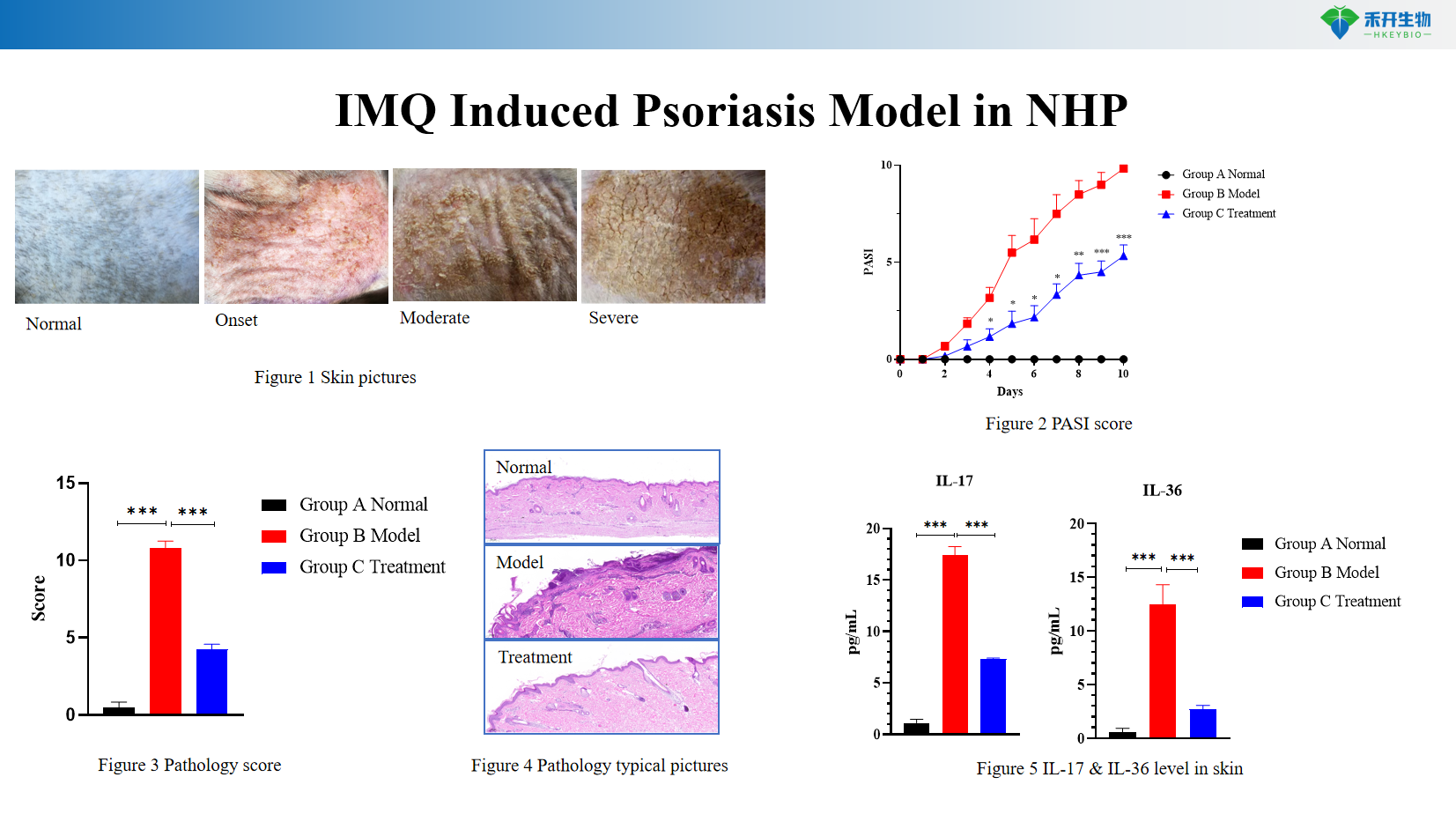
Well-characterized endpoints – PASI score (erythema, scaling, thickness), skin histopathology, IL-17A and IL-36 levels, clinical photography.
Mechanism-driven – IMQ activates TLR7/8, inducing IFN-α and IL-23/IL-17 pathway, closely mimicking human disease pathogenesis.
Translational value – Ideal for testing biologics (anti-IL-17, anti-IL-23), JAK inhibitors, and topical therapies.
IND-ready data packages – Studies can be conducted in accordance with GLP principles.
Technical Data & Validation
Representative data from our IMQ Induced NHP Psoriasis model:
IMQ Induced Psoriasis Model in NHP
Applications
• Efficacy testing of biologics (anti-IL-17, anti-IL-23, anti-TNF), JAK inhibitors, and topical therapies
• Target validation for Th17 pathway and IL-36 signaling
• Biomarker discovery (IL-17A, IL-36, other psoriasis-related mediators)
• Mechanism of action (MOA) studies
• IND-enabling toxicology and safety pharmacology studies
Model Specifications
Parameter | Specification |
Species | Cynomolgus macaque (Macaca fascicularis) |
Induction method | Daily topical application of 5% imiquimod (IMQ) cream for 5–14 days |
Study duration | 2–4 weeks (induction + treatment phase) |
Key endpoints | PASI score (erythema, scaling, thickness); skin histopathology (acanthosis, parakeratosis, inflammatory infiltrates); IL-17A and IL-36 levels (ELISA/qPCR); clinical photography |
Data package | Raw data, analysis reports, histology slides, clinical photographs, bioinformatics (optional) |
❓ Frequently Asked Questions
Q1: What is your NHP psoriasis model? A1: We provide the Imiquimod (IMQ)-induced psoriasis model using non-human primates (NHP). It successfully replicates typical skin lesions and immune changes of human psoriasis.
Q2: What is the mechanism of this IMQ-induced NHP model? A2: As a TLR agonist, IMQ triggers the secretion of type I IFN-α and activates relevant immune pathways, forming a feedback loop to cause erythema, scaling and thickening of skin, which is consistent with the pathogenesis of human psoriasis.
Q3: What evaluation indicators are used for model assessment? A3: We adopt PASI score for clinical symptom evaluation, detect key cytokines IL-17A and IL-36 in skin tissues, and conduct HE staining to analyze skin pathological changes.
Q4: What is the modeling timeline and operation steps? A4: Shave the skin on Day -1, apply IMQ cream daily starting from Day 0. All observations and detections are completed on Day 10.
Q5: What are the core advantages and applications of this model? A5: NHPs share high similarity with humans in skin structure and immune system. This model presents stable and typical psoriasis phenotypes, ideal for preclinical efficacy evaluation and mechanism research of anti-psoriasis drugs.


