Key Features & Benefits
Clinically relevant – Recapitulates human IIM: muscle weakness, inflammatory infiltration, and elevated pro-inflammatory cytokines (IL-6, IL-17A).
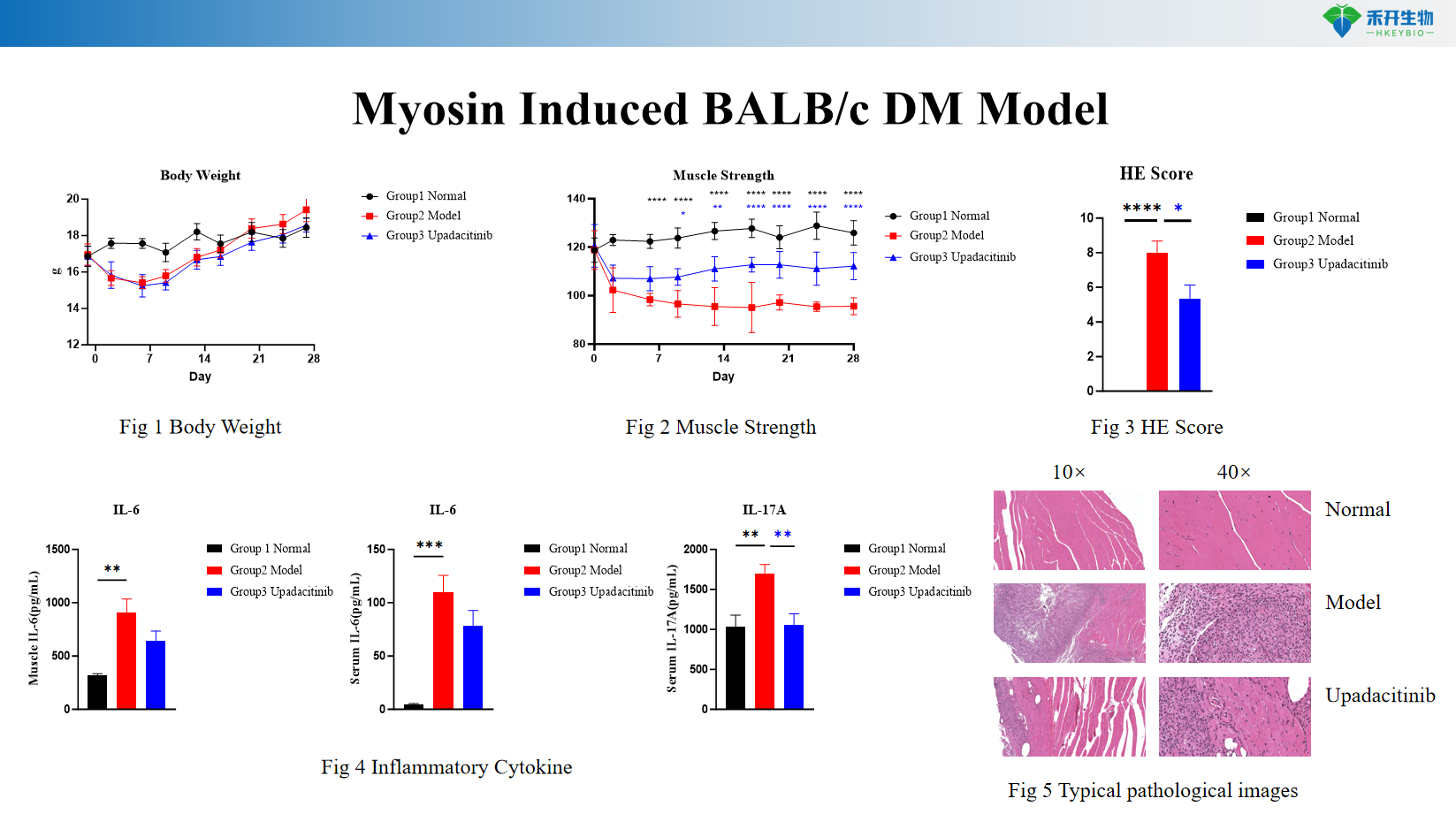
Quantifiable endpoints – Body weight, muscle strength (grip strength test), serum cytokine levels (IL-6, IL-17A), muscle histopathology (HE scoring), inflammatory cell infiltration.
Mechanism-driven – Myosin immunization triggers autoimmune response against skeletal muscle, involving both cellular (Th1/Th17) and humoral immunity, mirroring human myositis pathogenesis.
Translational value – Ideal for testing immunosuppressants (corticosteroids, methotrexate, mycophenolate), biologics targeting IL-6 (tocilizumab), IL-17 (secukinumab), and JAK inhibitors.
IND-ready data packages – Studies can be conducted in accordance with GLP principles.
Technical Data & Validation
Myosin Induced BALB/c DM Model
Applications
• Efficacy testing of immunosuppressants (corticosteroids, methotrexate, mycophenolate mofetil, cyclophosphamide)
• Evaluation of biologics targeting IL-6 (tocilizumab), IL-17 (secukinumab, ixekizumab), and JAK inhibitors (tofacitinib, baricitinib)
• Target validation for Th17 and Th1 pathways in autoimmune myositis
• Biomarker discovery (cytokine signatures, autoantibodies, muscle damage markers)
• IND-enabling pharmacology and toxicology studies
Model Specifications
Parameter | Specification |
Species/Strain | BALB/c mouse |
Induction method | Immunization with myosin protein (e.g., rabbit or bovine myosin) emulsified in CFA, with or without booster injections |
Study duration | 4–8 weeks post-immunization (depending on disease progression) |
Key endpoints | Body weight, muscle strength (grip strength test), serum cytokine levels (IL-6, IL-17A), muscle histopathology (HE staining with scoring for inflammation, necrosis, regeneration), optional: flow cytometry of muscle-infiltrating immune cells, anti-myosin autoantibodies |
Data package | Raw data, analysis reports, behavioral data, histology slides, cytokine ELISA results, bioinformatics (optional) |
❓ Frequently Asked Questions
Q1: What IIM preclinical model do you provide? A1: We offer a myosin-induced dermatomyositis (DM) model using BALB/c mice for idiopathic inflammatory myopathies research.
Q2: What is the modeling mechanism? A2: Myosin induction triggers abnormal immune responses, leading to muscle inflammation and tissue damage. It well recapitulates the pathological features of human idiopathic inflammatory myopathies.
Q3: What evaluation indicators are adopted? A3: We monitor body weight and muscle strength clinically. We also detect inflammatory cytokines IL-6 and IL-17A, and conduct HE staining for muscle pathological assessment.
Q4: What is the modeling timeline? A4: Myosin is administrated on Day 0 and Day 4. The whole experiment lasts 28 days until all tests and observations are completed.
Q5: What are the advantages and applications? A5: This model features stable inflammatory lesions and reliable repeatability. It is widely used for efficacy screening and mechanism study of drugs treating autoimmune myopathies.


