Key Features & Benefits
Clinically relevant – Recapitulates human hyperuricemia with elevated serum uric acid, suitable for studying gout and uric acid nephropathy.
Mechanism-driven – Potassium oxonate inhibits uricase (the enzyme that degrades uric acid in rodents), mimicking human uric acid metabolism; adenine increases purine load.
Quantifiable endpoint – Serum uric acid levels measured by colorimetric or enzymatic assays.
Translational value – Ideal for testing xanthine oxidase inhibitors (allopurinol, febuxostat), uricosuric agents, and novel urate-lowering compounds.
IND-ready data packages – Studies can be conducted in accordance with GLP principles.
Technical Data & Validation
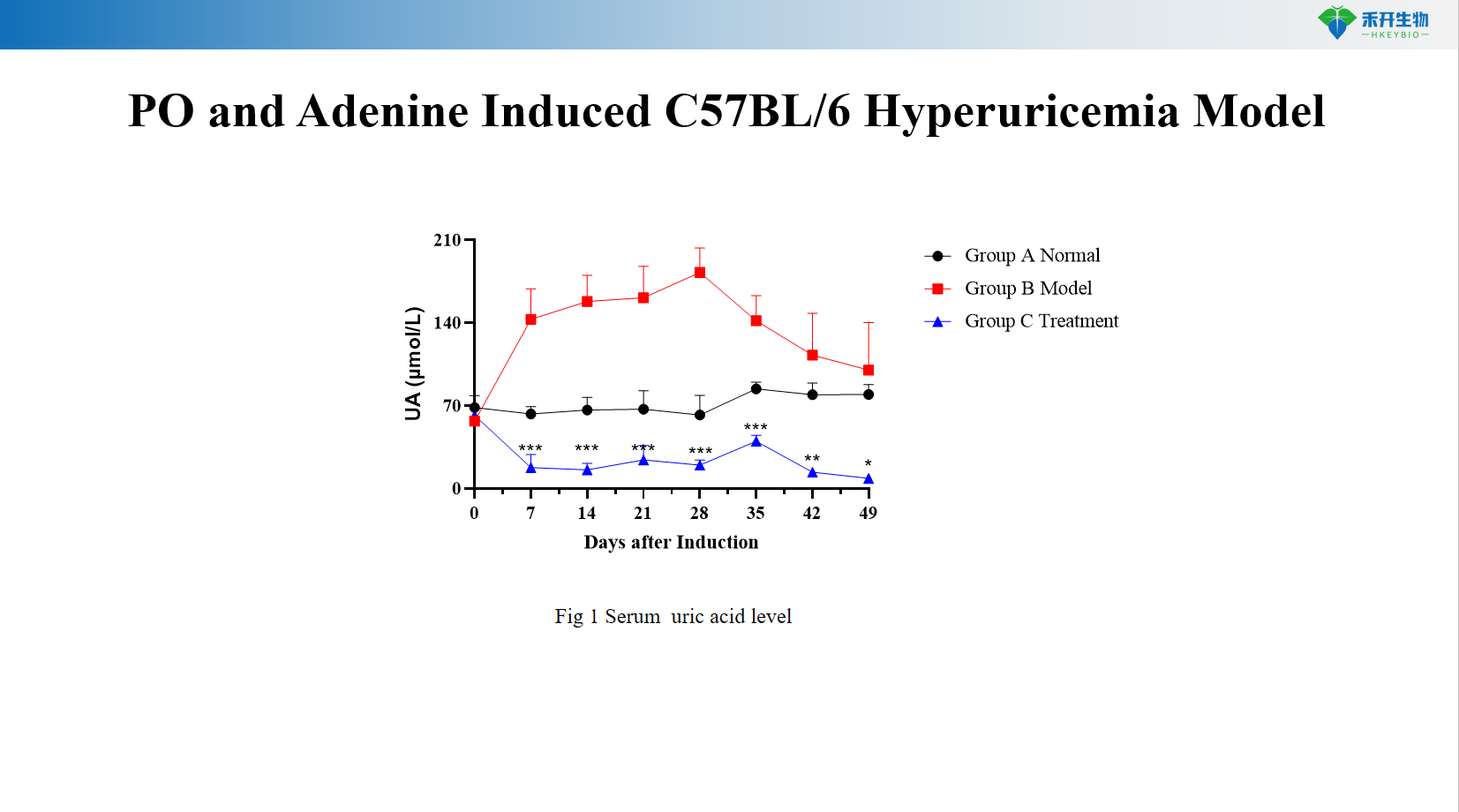
PO and Adenine Induced C57BL/6 Hyperuricemia Model
Applications
• Efficacy testing of xanthine oxidase inhibitors (allopurinol, febuxostat, topiroxostat)
• Evaluation of uricosuric agents (probenecid, benzbromarone, lesinurad)
• Target validation for uric acid metabolism pathways
• Biomarker discovery (uric acid, xanthine oxidase activity, renal function markers)
• IND-enabling pharmacology and toxicology studies
Model Specifications
Parameter | Specification |
Species/Strain | C57BL/6 mouse |
Induction method | Oral administration of potassium oxonate (250–500 mg/kg) + adenine (50–100 mg/kg), daily for 7–14 days, often combined with high-purine diet |
Study duration | 1–3 weeks (induction + treatment phase) |
Key endpoints | Serum uric acid levels, optional: serum creatinine, BUN, xanthine oxidase activity, renal histopathology, urinary uric acid excretion |
| Positive control | Allopurinol (xanthine oxidase inhibitor) available as reference compound |
Data package | Raw data, analysis reports, clinical chemistry results, bioinformatics (optional) |
❓ Frequently Asked Questions
Q1: What hyperuricemia model do you provide? A1: We establish a stable hyperuricemia model in C57BL/6 mice induced by combined administration of Potassium Oxonate (PO) and adenine.
Q2: How does this model work? A2: Potassium oxonate inhibits uricase activity, while adenine elevates purine metabolism. The combination effectively raises serum uric acid and mimics pathological changes of clinical hyperuricemia.
Q3: What main detection indicators are used? A3: The core evaluation indicator is serum uric acid level to directly reflect the modeling effect and disease severity.
Q4: What is the modeling operation? A4: PO and adenine are administrated starting from Day 0. Related sample collection and tests are performed when the model is fully established.
Q5: What are the model advantages and applications? A5: This model features simple operation, high success rate and good stability. It is widely used for efficacy screening and mechanism research of anti-hyperuricemia and anti-gout drugs.


