Key Features & Benefits
Clinically relevant – Recapitulates human PsA with concurrent skin and joint inflammation, TNF-α/IL-17 axis involvement.
Multiple strains – DBA/1 (high susceptibility) and C57BL/6 (moderate, suitable for transgenic studies) available.
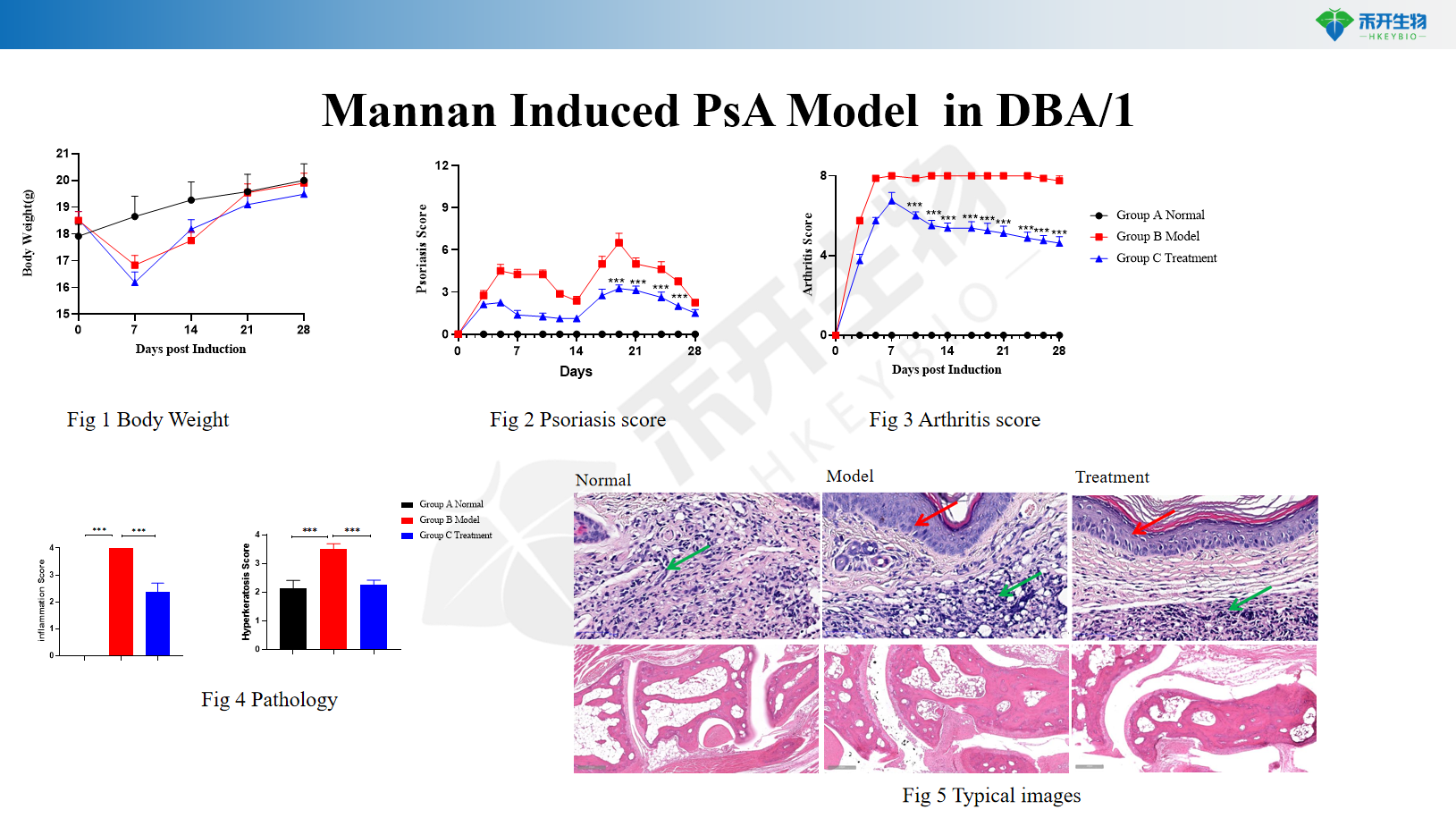
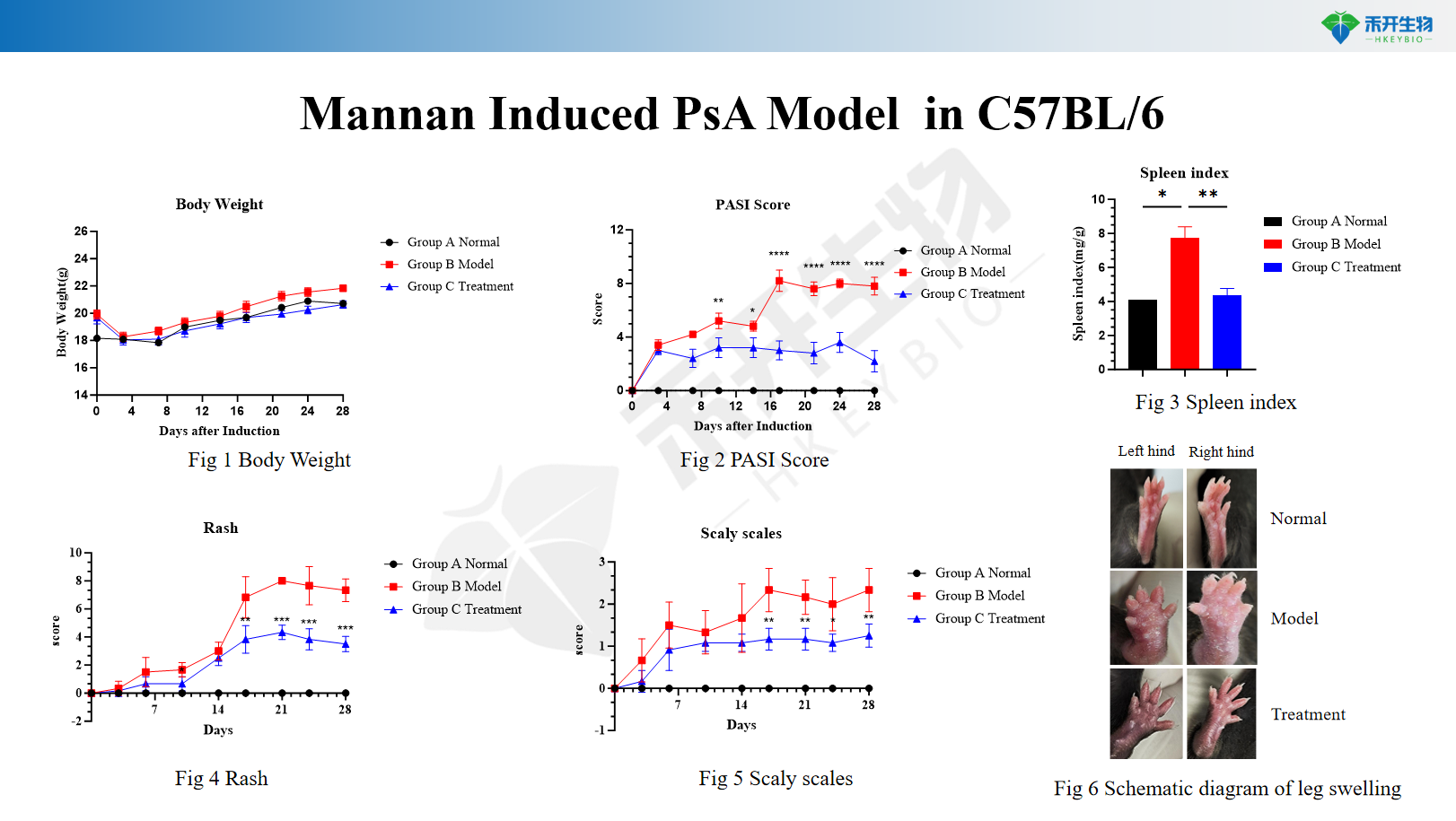
Comprehensive endpoints – Body weight, psoriasis score, arthritis score, skin and joint histopathology (HE), splenomegaly, cytokine profiling.
Translational value – Ideal for testing biologics (anti-TNF, anti-IL-17, anti-IL-23), JAK inhibitors, and immunomodulators.
IND-ready data packages – Studies can be conducted in accordance with GLP principles.
Technical Data & Validation
Mannan Induced PsA Model in DBA/1
Mannan Induced PsA Model in C57BL/6
Applications
• Efficacy testing of biologics targeting TNF-α (etanercept, adalimumab), IL-17 (secukinumab, ixekizumab), and IL-23 (guselkumab)
• Evaluation of JAK inhibitors (tofacitinib, upadacitinib), PDE4 inhibitors (apremilast), and small molecule immunomodulators
• Target validation for Th17/IL-17 axis and macrophage-T cell interactions in PsA
• Biomarker discovery (cytokine profiles, immune cell subsets)
• IND-enabling pharmacology and toxicology studies
Model Specifications
Parameter | DBA/1 PsA Model | C57BL/6 PsA Model |
Species/Strain | DBA/1 mouse | C57BL/6 mouse |
Induction method | Intraperitoneal injection of mannan (10–20 mg/mouse) on day 0 and day 7 |
Study duration | 7–21 days | 7–21 days |
Key endpoints | Body weight, psoriasis score (0–4), arthritis score (0–4), skin/joint histopathology (HE), splenomegaly, serum cytokines (TNF-α, IL-17A) | Body weight, psoriasis score (0–4), arthritis score (0–4), skin/joint histopathology (HE), splenomegaly, optional flow cytometry |
| Positive control | Anti-TNF antibody or dexamethasone | Anti-TNF antibody or dexamethasone |
Data package | Raw data, analysis reports, clinical scores, histology slides | Raw data, analysis reports, clinical scores, histology slides |
❓ Frequently Asked Questions
Q1: What PsA preclinical models do you provide? A1: We offer mannan-induced psoriatic arthritis models in DBA/1 and C57BL/6 mice, as well as mcIL-23 plasmid-induced PsA model in NOD mice for related research.
Q2: What is the mechanism of the mannan-induced PsA model? A2: Mannan triggers macrophages to secrete TNF-α, which activates T cells and increases IL-17A. This recruits neutrophils and induces typical skin lesions and joint inflammation consistent with human PsA.
Q3: What evaluation indicators are used for model assessment? A3: We monitor body weight, psoriasis score and arthritis score clinically. Spleen index is measured and HE staining is performed to analyze pathological changes of skin and joints.
Q4: What is the modeling cycle and operation process? A4: The modeling starts with injection of mannan combined with CFA on Day 0, followed by additional mannan administration. The whole experiment lasts for 28 days.
Q5: What are the advantages and application scenarios of these models?
A5: The models simultaneously recapitulate both psoriasis and arthritis symptoms with stable inflammatory phenotypes. They are ideal for preclinical efficacy screening and mechanism study of drugs against psoriatic arthritis.


