Key Features & Benefits
Clinically relevant – Mimics human SjS: reduced salivary flow, anti-salivary gland antibodies, glandular lymphocytic infiltration.
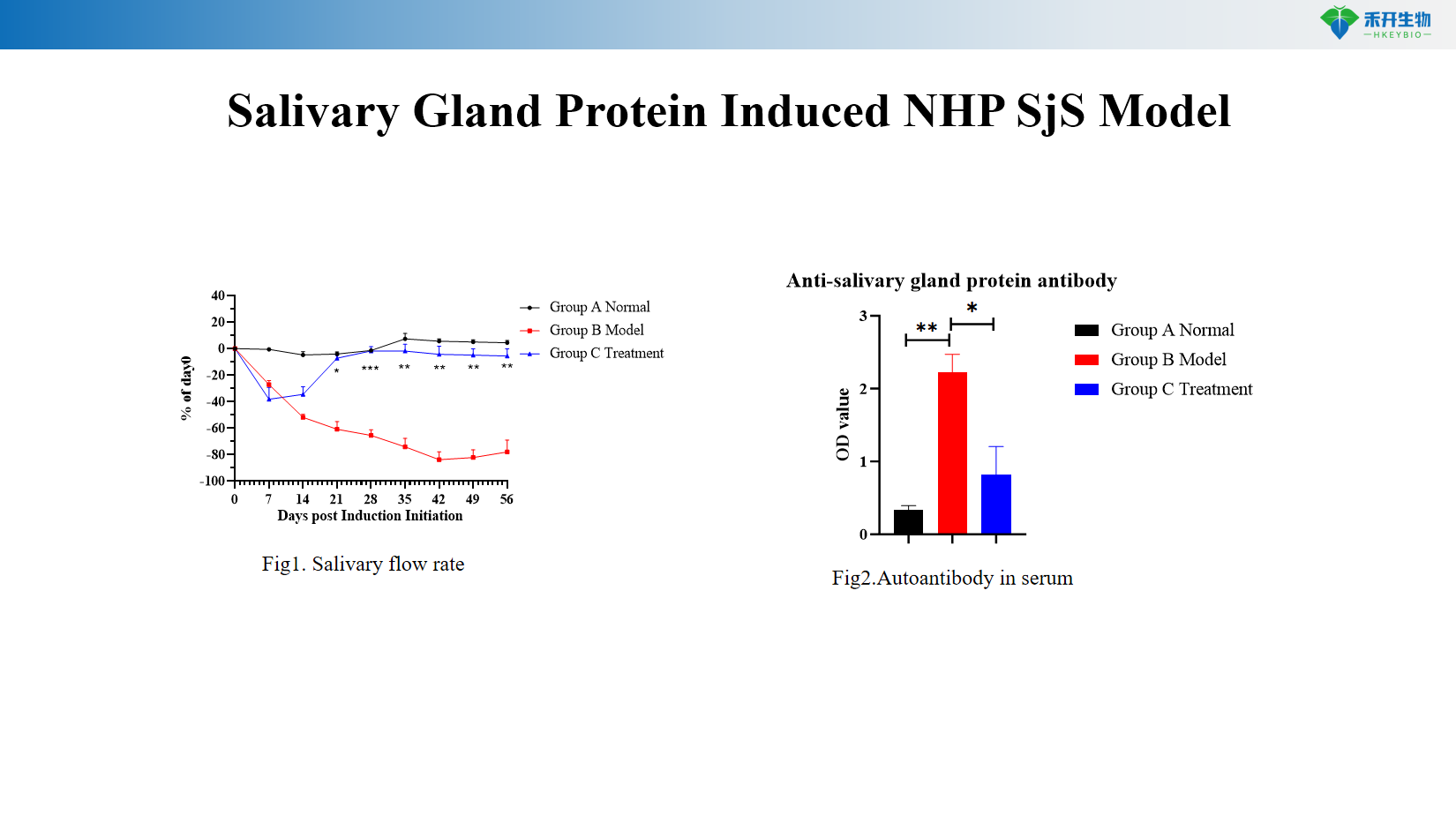
Quantifiable endpoints – Salivary flow rate measurement, autoantibody titers, histopathology of salivary and lacrimal glands.
Translational value – Ideal for testing biologics, JAK inhibitors, and immunomodulators targeting autoimmune exocrinopathy.
Multi-system evaluation – Assess both glandular and extra-glandular manifestations (arthritis, lupus-like features if present).
IND-ready data packages – Studies can be conducted in accordance with GLP principles.
Technical Data & Validation
Representative data from our NHP SjS model:
Salivary Gland Protein Induced NHP SjS Model
Applications
• Efficacy testing of biologics (anti-CD20, anti-BAFF, anti-IL-6), JAK inhibitors, and immunomodulators
• Target validation for autoimmune exocrinopathy pathways
• Biomarker discovery (autoantibodies, salivary proteins, inflammatory mediators)
• Mechanism of action (MOA) studies
• IND-enabling toxicology and safety pharmacology studies
Model Specifications
Parameter | Specification |
Species | Cynomolgus macaque (Macaca fascicularis) |
Induction method | Immunization with salivary gland protein extract emulsified in adjuvant (e.g., CFA/IFA), with booster injections |
Study duration | 8–14 weeks (induction + treatment phase) |
Key endpoints | Salivary flow rate, anti-salivary gland protein antibodies (IgG), histopathology of salivary/lacrimal glands (focus score), tear production (Schirmer's test), optional: cytokine profiling, immune cell phenotyping |
Data package | Raw data, analysis reports, histology slides, bioinformatics (optional) |
❓ Frequently Asked Questions
Q1: What is your NHP Sjogren’s Syndrome (SjS) model? A1: It is a salivary gland protein-induced SjS model established with non-human primates (NHP). By immunization with salivary gland protein combined with adjuvant, it mimics the typical symptoms and pathological changes of human Sjogren’s syndrome.
Q2: What is the core pathogenesis of this model? A2: Repeated immunization with salivary gland protein triggers autoimmune responses in NHPs. It causes glandular lesions, reduced saliva secretion and related pathological damages, which highly recapitulate the etiology of human SjS.
Q3: What evaluation indicators are used for model detection? A3: We assess body weight and salivary flow rate clinically, test serum autoantibodies, and perform HE staining to observe inflammatory infiltration, acinar atrophy and other pathological changes of salivary glands.


