Key Features & Benefits
Clinically relevant – Mimics human postoperative pain with incisional injury, mechanical allodynia, and inflammatory response.
Quantifiable endpoints – Mechanical withdrawal threshold (von Frey filaments), spontaneous pain scoring, weight-bearing asymmetry, optional: thermal sensitivity.
Highly reproducible – Standardized surgical protocol ensures consistent pain behavior across experiments.
Translational value – Ideal for testing non-opioid analgesics, NSAIDs, local anesthetics, and novel pain management strategies.
IND-ready data packages – Studies can be conducted in accordance with GLP principles.
Technical Data & Validation
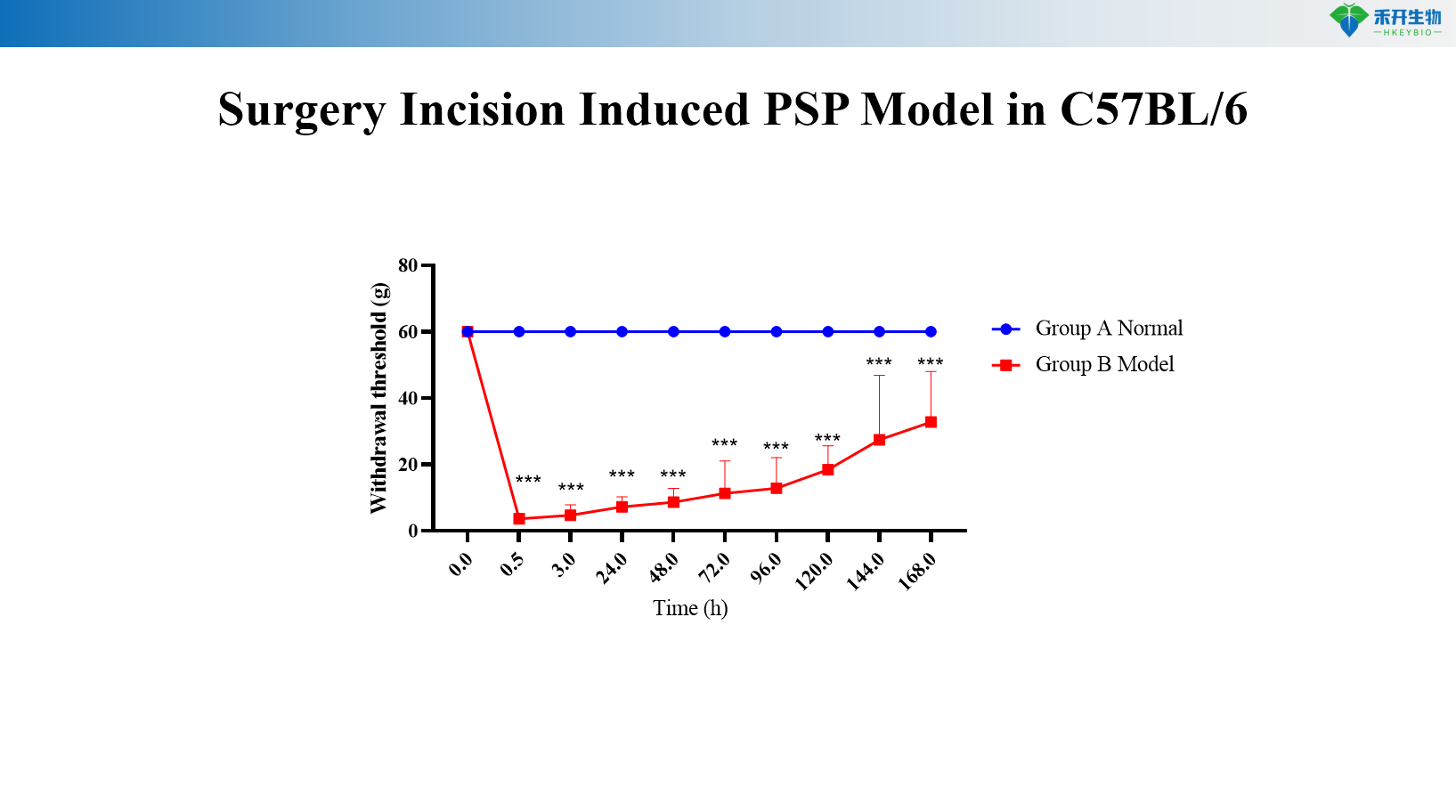
Surgery Incision Induced PSP Model in C57BL/6
Applications
• Efficacy testing of non-opioid analgesics (NSAIDs, COX-2 inhibitors, acetaminophen)
• Evaluation of novel analgesics including sodium channel blockers, TRPV1 antagonists, and neurokinin receptor antagonists
• Target validation for peripheral and central sensitization pathways
• Biomarker discovery (inflammatory mediators, pain-related neuropeptides)
• IND-enabling pharmacology and toxicology studies
Model Specifications
Parameter | Specification |
Species/Strain | C57BL/6 mouse |
Induction method | Plantar incision (1 cm longitudinal incision through skin, fascia, and muscle of the hind paw) under isoflurane anesthesia |
Study duration | 1–14 days (acute pain phase) |
Key endpoints | Mechanical withdrawal threshold (von Frey filaments), spontaneous pain scoring (guarding, licking, lifting), weight-bearing asymmetry (incapacitance meter), optional: thermal hyperalgesia (Hargreaves), gait analysis, inflammatory cytokine levels (ELISA/qPCR) |
| Positive control | NSAIDs (e.g., ibuprofen, ketorolac) or gabapentin available as reference compounds |
Data package | Raw data, analysis reports, behavioral data, bioinformatics (optional) |
❓ Frequently Asked Questions
Q1: What post-surgery pain model do you provide? A1: We offer a surgery incision-induced postoperative pain model using C57BL/6 mice for preclinical analgesic drug research.
Q2: What is the modeling mechanism? A2: Surgical tissue and nerve damage triggers inflammatory responses and changes in peripheral and central nervous systems, which fully simulates clinical acute post-surgery pain.
Q3: What evaluation indicator is mainly used? A3: We detect paw withdrawal threshold to assess mechanical pain sensitivity and evaluate the pain degree of model animals.
Q4: What is the modeling cycle? A4: Surgical incision is performed on Day 0. Relevant behavioral tests and observations last for 7 days until the end of the experiment.
Q5: What are the advantages and applications? A5: This model features simple operation and excellent reproducibility. It is widely applied for efficacy verification and mechanism study of new analgesic drugs for postoperative pain relief.
Q: What is the typical timeline for a pilot efficacy study?
A: Acute pain studies are typically completed within 7 days post-incision, with behavioral testing at baseline, post-surgery, and multiple time points (e.g., 2h, 6h, 24h, 48h, 72h, 7d).


