Key Features & Benefits
Clinically relevant – Recapitulates human type I hypersensitivity: IgE-mediated mast cell degranulation and wheal-and-flare reaction.
Quantifiable endpoints – Clinical feature scoring (wheal size, erythema, edema), localized skin reaction measurement.
Mechanism-driven – Direct assessment of IgE/FcεRI pathway and mast cell function in vivo.
Translational value – Ideal for testing anti-IgE biologics (omalizumab, ligelizumab), mast cell stabilizers (cromolyn, ketotifen), H1-antihistamines, and other anti-allergic agents.
IND-ready data packages – Studies can be conducted in accordance with GLP principles.
Technical Data & Validation
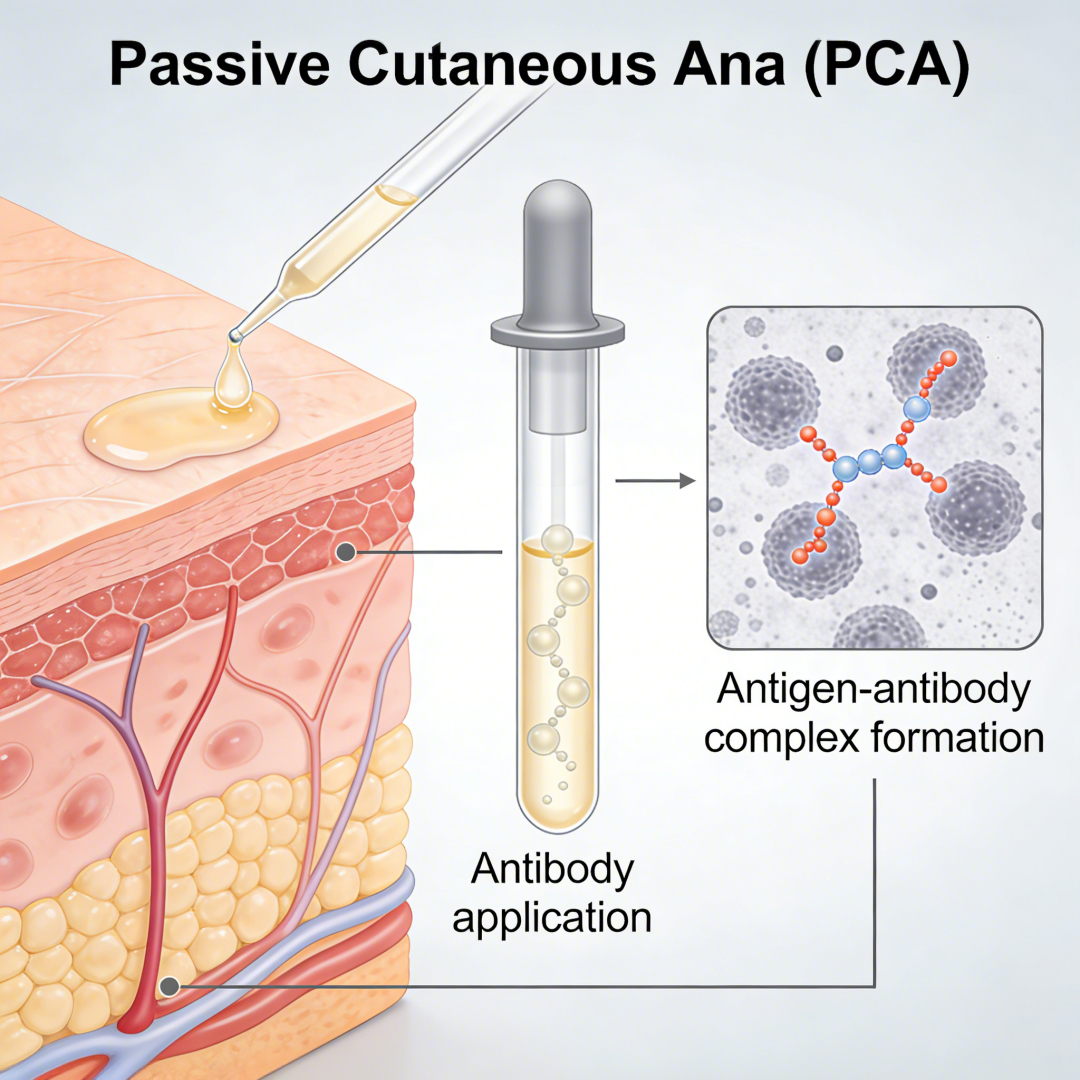
DNP-IgE & DNFB Induced NHP PCA Model
Applications
• Efficacy testing of anti-IgE biologics (omalizumab, ligelizumab, other anti-IgE antibodies)
• Evaluation of mast cell stabilizers (cromolyn, ketotifen, nedocromil) and H1-antihistamines
• Target validation for IgE/FcεRI pathway and mast cell biology
• Biomarker discovery (IgE, mast cell mediators)
• IND-enabling pharmacology and toxicology studies
Model Specifications
Parameter | Specification |
Species/Strain | Cynomolgus macaque (Macaca fascicularis) |
Induction method | Intradermal injection of DNP-specific IgE (day 1) followed by topical application of DNFB on same site (day 2) |
Study duration | 2–3 days (sensitization + challenge) |
Key endpoints | Clinical feature scoring (wheal size, erythema, edema), localized skin reaction measurement (diameter, thickness), optional: skin histopathology (mast cell degranulation), serum IgE levels |
Data package | Raw data, analysis reports, clinical photographs, histology slides (optional), bioinformatics (optional)Raw data, analysis reports, clinical chemistry, urine analysis, histology slides, bioinformatics (optional) |
❓ Frequently Asked Questions
Q: How does the DNP-IgE & DNFB induced PCA model work?
A: DNP-specific IgE is passively transferred by intradermal injection, binding to FcεRI receptors on mast cells. Subsequent topical DNFB challenge at the same site cross-links bound IgE, triggering mast cell degranulation, histamine release, and a localized wheal-and-flare reaction.
Q: What are the key similarities with human type I hypersensitivity?
A: The model exhibits IgE-mediated mast cell activation, histamine release, vasodilation, and localized edema, directly mirroring human allergic reactions such as urticaria and anaphylaxis.
Q: Can this model be used for IND-enabling studies?
A: Yes. Studies can be conducted in accordance with GLP principles for regulatory submissions (FDA, EMA).
Q: Do you offer customized study protocols (e.g., different IgE doses, challenge concentrations)?
A: Absolutely. Our scientific team tailors IgE concentrations, challenge protocols, and endpoint analyses to your specific drug candidate.
Q: What is the typical timeline for a pilot efficacy study?
A: The model is completed within 2–3 days, allowing rapid screening of anti-allergic compounds.


