Key Features & Benefits
Clinically relevant – Recapitulates human glucocorticoid-induced osteoporosis with suppressed bone formation, enhanced resorption, and microarchitectural deterioration.
Multiple species – Rat and mouse models available to suit different experimental needs (larger size vs. genetic manipulation).
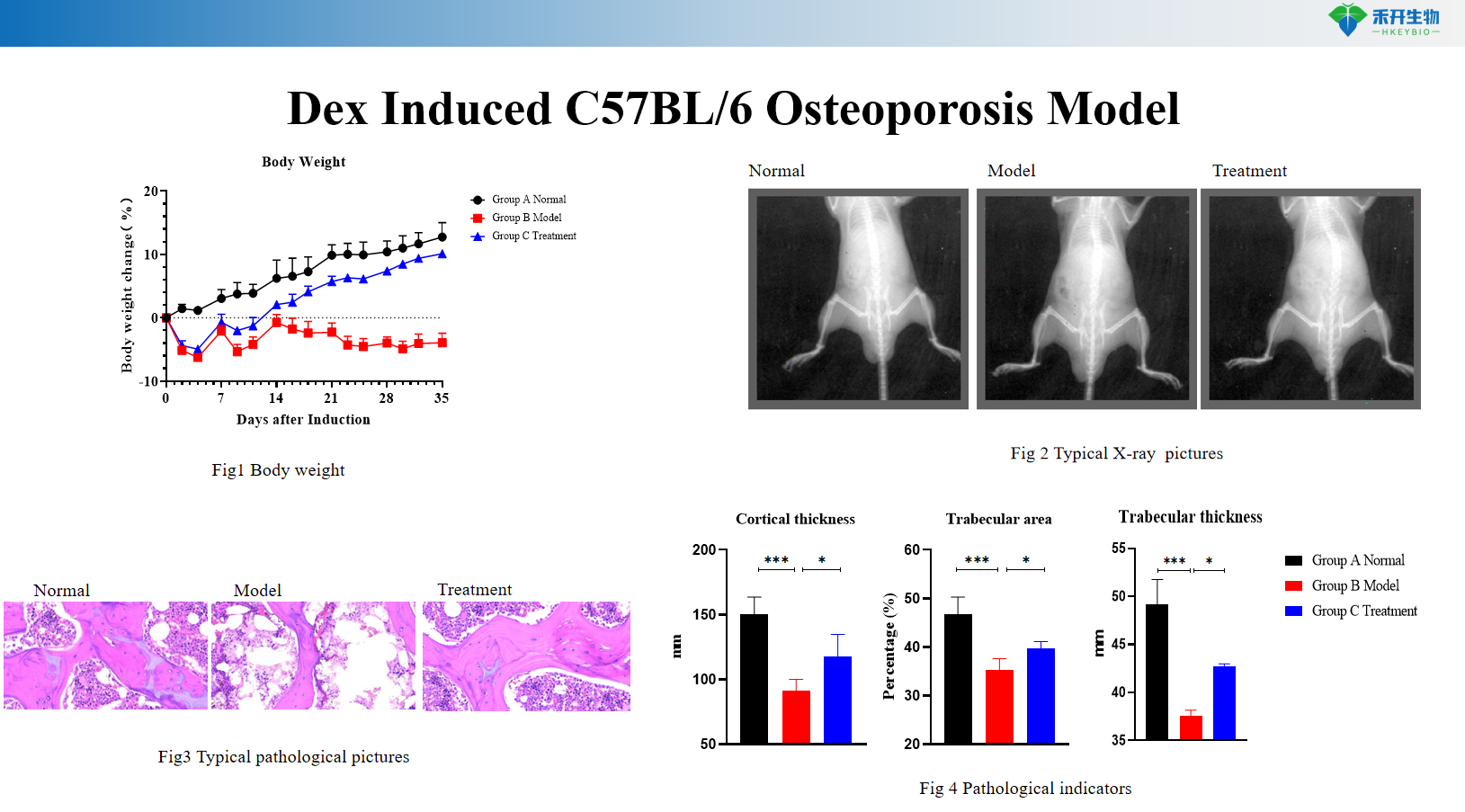
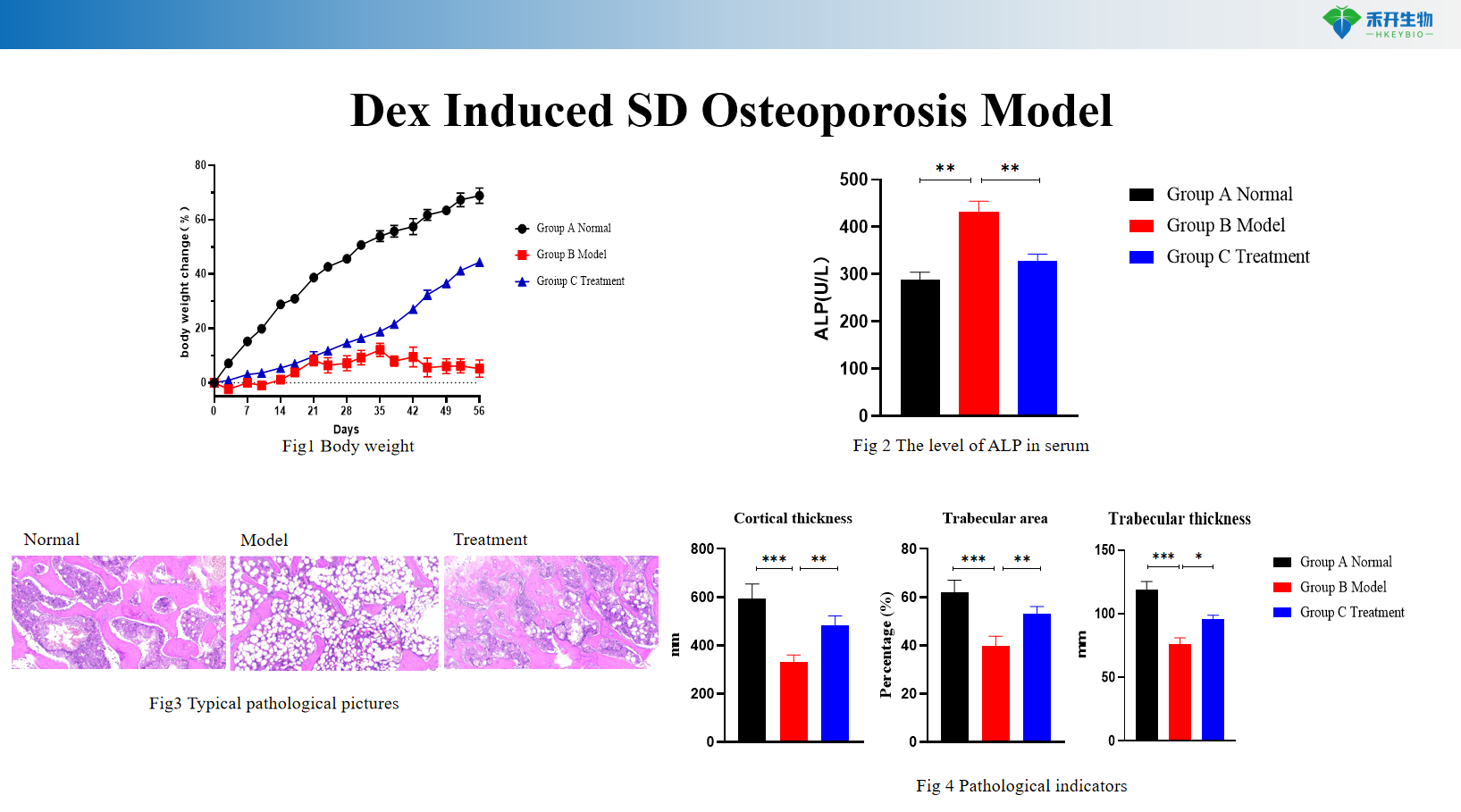
Comprehensive endpoints – Body weight, serum ALP, X-ray imaging, histopathology (H&E, TRAP staining), bone histomorphometry, micro-CT (optional).
Translational value – Ideal for testing bisphosphonates (alendronate), SERMs (raloxifene), anabolic agents (teriparatide), and RANKL inhibitors.
IND-ready data packages – Studies can be conducted in accordance with GLP principles.
Technical Data & Validation
Dex Induced C57BL/6 Osteoporosis Model
Dex Induced SD Osteoporosis Model
Applications
• Efficacy testing of anti-osteoporotic agents: bisphosphonates (alendronate, zoledronic acid), SERMs (raloxifene), anabolic agents (teriparatide, romosozumab), and RANKL inhibitors (denosumab)
• Evaluation of novel therapies targeting bone formation or resorption pathways
• Target validation for glucocorticoid-induced osteoporosis mechanisms
• Biomarker discovery (bone turnover markers, ALP, osteocalcin, CTX-I)
• IND-enabling pharmacology and toxicology studies
Model Specifications
Parameter | SD Rat OP Model | C57BL/6 Mouse OP Model |
Species/Strain | Sprague-Dawley rat | C57BL/6 mouse |
Induction method | Dexamethasone (1–2.5 mg/kg) administered intramuscularly or subcutaneously, 2–3 times/week for 4–8 weeks |
Study duration | 4–10 weeks (induction + treatment phase) |
Key endpoints | Body weight, serum ALP, X-ray imaging, histopathology (H&E, TRAP), bone histomorphometry, micro-CT (optional) | Body weight, serum ALP, histopathology, micro-CT (optional) |
| Positive control | Alendronate or teriparatide available as reference compounds |
Data package | Raw data, analysis reports, X-ray images, histology slides, micro-CT data (optional), bioinformatics (optional) |
❓ Frequently Asked Questions
Q1: What osteoporosis model do you provide? A1: We offer dexamethasone (Dex)-induced osteoporosis models using SD rats and C57BL/6 mice for preclinical research on secondary osteoporosis.
Q2: What is the modeling mechanism? A2: Dexamethasone, a glucocorticoid, inhibits bone formation and disrupts bone metabolism. It reduces bone mass and damages bone microarchitecture, perfectly simulating glucocorticoid-induced secondary osteoporosis in humans.
Q3: What evaluation indicators are applied? A3: We monitor body weight, detect serum ALP levels, and perform X-ray imaging and H&E staining to assess bone structure and pathological changes.
Q4: What is the modeling operation? A4: Dexamethasone is administrated twice per week starting from Day 0. All detections and observations are carried out after the model is fully established.
Q5: What are the advantages and applications? A5: This model features stable bone loss phenotypes and high reproducibility. It is widely used for efficacy screening and mechanism research of anti-osteoporosis and bone-protective drugs.


