Key Features & Benefits
Clinically relevant – Recapitulates human KOA: cartilage degeneration, joint swelling, and pain-related behaviors.
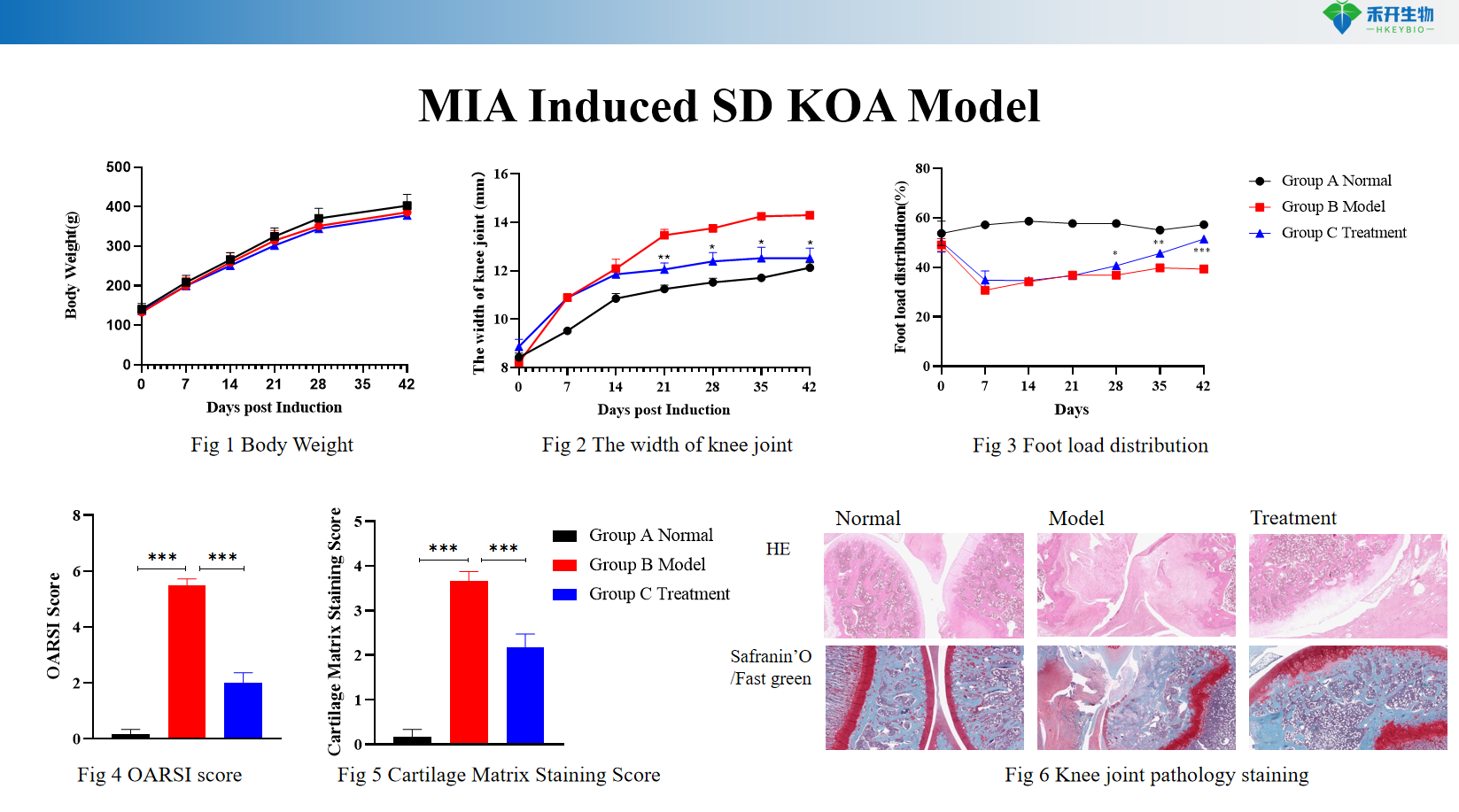
Quantifiable endpoints – Body weight, knee joint width (caliper measurement), foot load distribution (weight-bearing asymmetry), cartilage matrix staining score (Safranin O/Fast green), histopathology (HE, toluidine blue).
Mechanism-driven – MIA inhibits chondrocyte glycolysis, inducing apoptosis and progressive cartilage degradation, mimicking the metabolic and structural changes in osteoarthritis.
Translational value – Ideal for testing disease-modifying osteoarthritis drugs (DMOADs), analgesics (NSAIDs, opioids), and anti-inflammatory agents.
IND-ready data packages – Studies can be conducted in accordance with GLP principles.
Technical Data & Validation
MIA Induced SD KOA Model
Applications
• Efficacy testing of disease-modifying osteoarthritis drugs (DMOADs) including cathepsin K inhibitors, Wnt pathway modulators, and anabolic agents
• Evaluation of analgesics (NSAIDs, COX-2 inhibitors, opioids, cannabinoids) for osteoarthritis pain
• Target validation for cartilage degradation and pain pathways
• Biomarker discovery (cartilage degradation markers, inflammatory mediators)
• IND-enabling pharmacology and toxicology studies
Model Specifications
Parameter | Specification |
Species/Strain | Sprague-Dawley (SD) rat |
Induction method | Intra-articular injection of monoiodoacetate (MIA, 1–3 mg in 50 μL saline) into the knee joint |
Study duration | 1–8 weeks (acute to chronic phases) |
Key endpoints | Body weight, knee joint width (caliper), foot load distribution (weight-bearing asymmetry), cartilage matrix staining score (Safranin O/Fast green), histopathology (HE, toluidine blue, OARSI score), optional: mechanical allodynia (von Frey), gait analysis, serum biomarkers (COMP, CTX-II) |
| Positive control | NSAIDs (e.g., indomethacin) or DMOADs available as reference compounds |
Data package | Raw data, analysis reports, histology slides, behavioral data, bioinformatics (optional) |
❓ Frequently Asked Questions
Q1: What knee osteoarthritis model do you provide? A1: We provide a mature monoiodoacetate (MIA)-induced KOA model using Sprague Dawley (SD) rats for preclinical OA research.
Q2: What is the modeling mechanism? A2: Intra-articular injection of MIA inhibits aerobic glycolysis of chondrocytes and triggers chondrocyte apoptosis. It effectively induces joint degeneration and pain, simulating the pathological features of human knee osteoarthritis.
Q3: What evaluation indicators are used? A3: We assess body weight and knee joint width clinically. We also detect foot load distribution, calculate OARSI scores, and perform special staining for cartilage pathological analysis.
Q4: What is the experimental cycle? A4: A single MIA injection is performed on Day 0. The whole experiment lasts 42 days until all observations and tests are completed.
Q5: What are the advantages and applications? A5: This model has stable lesions, obvious pain symptoms and good repeatability. It is widely used for efficacy screening and mechanism study of anti-osteoarthritis and analgesic drugs.


