Key Features & Benefits
Etiologically relevant – Induced by cigarette smoke, the primary cause of human COPD.
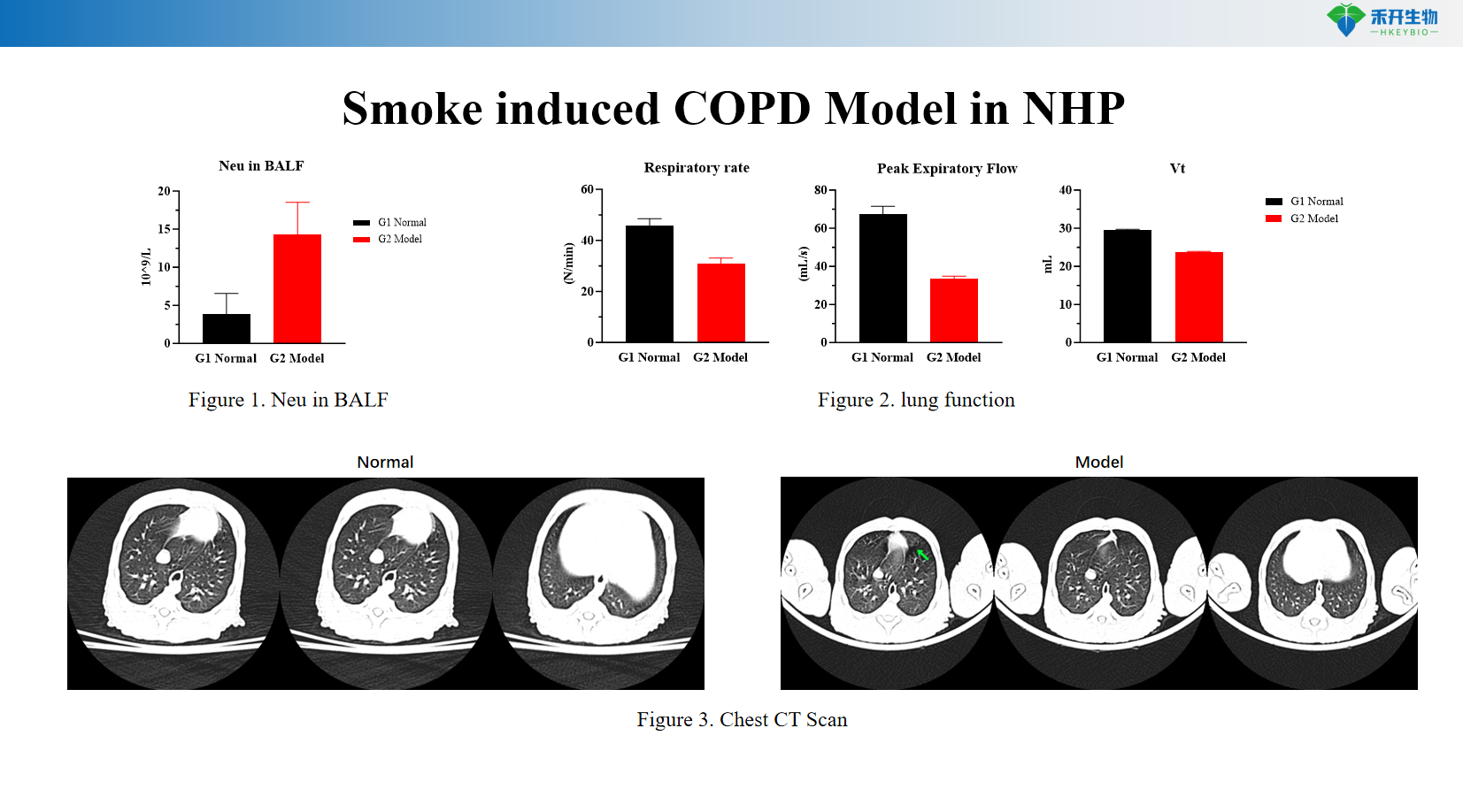
Clinically translatable endpoints – Lung function testing, chest CT imaging, BALF cytology (neutrophils), body weight monitoring.
Chronic inflammation – Reproducible airway neutrophilia and structural lung damage.
Multi-system evaluation – Assess both pulmonary and systemic effects of test compounds.
IND-ready data packages – Studies can be conducted in accordance with GLP principles.
Technical Data & Validation
Representative data from our Cigarette Smoke Induced NHP COPD model:
Smoke induced COPD Model in NHP
Applications
• Efficacy testing of anti-inflammatory drugs for COPD (e.g., PDE4 inhibitors, corticosteroids, biologics)
• Target validation for neutrophil-mediated airway diseases
• Biomarker discovery (BALF cytology, cytokines, imaging biomarkers)
• Mechanism of action (MOA) studies
• IND-enabling toxicology and safety pharmacology studies
Model Specifications
Parameter | Specification |
Species | Cynomolgus macaque (Macaca fascicularis) |
Induction method | Chronic whole-body or nose-only exposure to cigarette smoke (daily, 3-6 months) |
Study duration | 3–6 months (induction phase) + treatment phase |
Key endpoints | Body weight, lung function (spirometry), BALF cytology (neutrophils), chest CT imaging, histopathology (optional) |
Data package | Raw data, analysis reports, CT images, BALF cytology reports, bioinformatics (optional) |
❓ Frequently Asked Questions
Q1: What COPD preclinical model do you provide? A1: We offer a cigarette smoke (CS)-induced chronic obstructive pulmonary disease model using non-human primates (NHP).
Q2: What is the modeling mechanism? A2: Long-term cigarette smoke exposure triggers persistent airway inflammation, increases neutrophil infiltration and impairs airflow, which fully simulates the pathogenesis of human COPD.
Q3: What evaluation indicators are used? A3: We monitor body weight, detect lung function and perform chest CT scanning. We also test neutrophil levels in bronchoalveolar lavage fluid (BALF).
Q4: What is the experimental cycle? A4: Cigarette smoke is administrated twice daily starting from Day 0. The whole experiment lasts 84 days.
Q5: What are the advantages and applications? A5: This NHP model shares high similarity with human respiratory physiology and disease progression. It is ideal for efficacy evaluation and mechanism research of anti-COPD drugs.


