Key Features & Benefits
Clinically relevant – CCl4 induced fibrosis recapitulates human liver fibrosis with progressive extracellular matrix deposition and liver dysfunction.
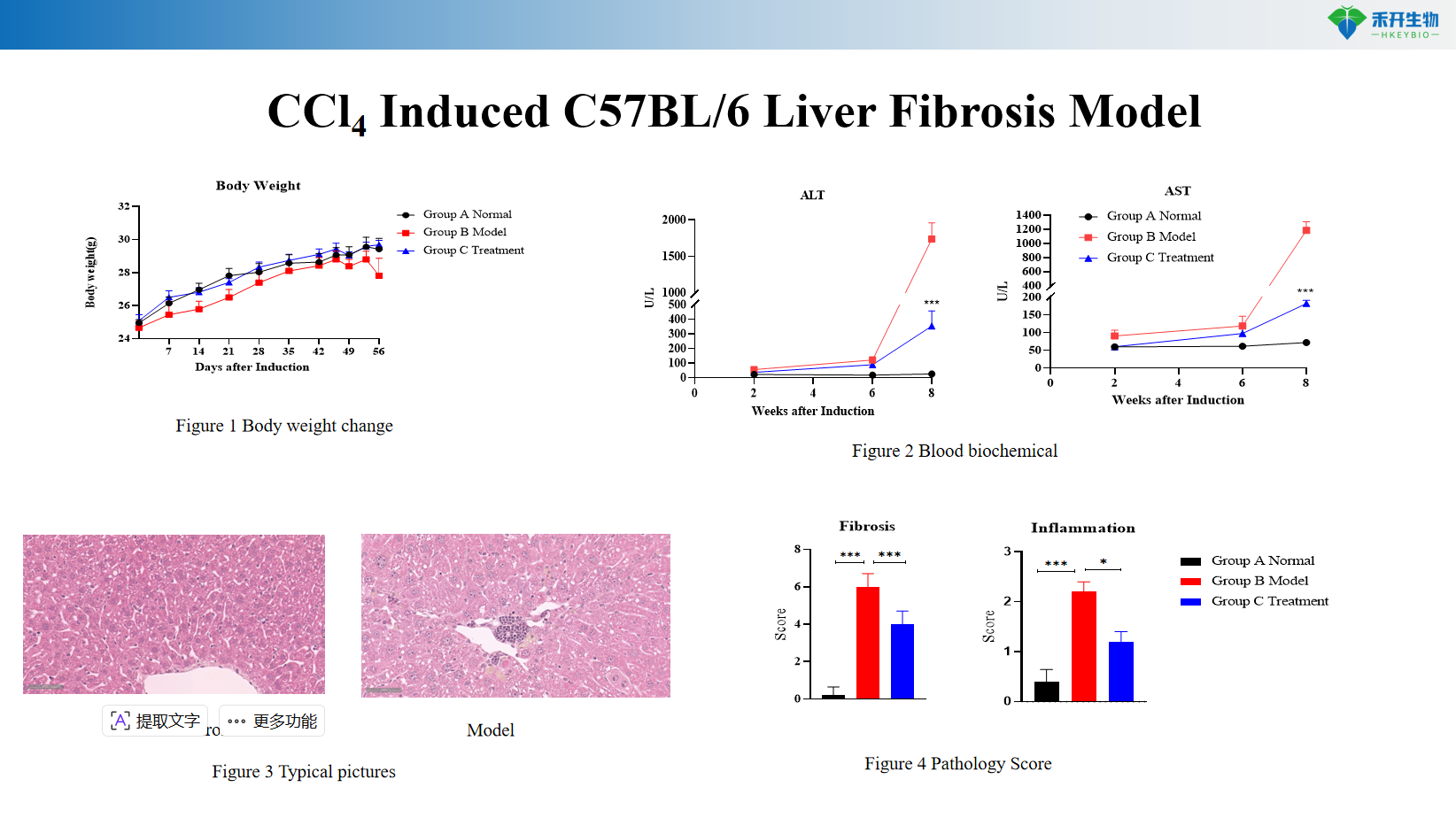
Comprehensive endpoints – Body weight, serum ALT and AST (liver injury markers), liver histopathology (HE, Masson trichrome, Sirius Red), fibrosis scoring.
Reproducible and well-characterized – Widely used model with established protocols and high reproducibility across experiments.
Translational value – Ideal for testing anti-fibrotic agents (nintedanib, pirfenidone), antioxidants, and hepatoprotective compounds.
IND-ready data packages – Studies can be conducted in accordance with GLP principles.
Technical Data & Validation
CCl4 Induced C57BL/6 Liver Fibrosis Model
Applications
• Efficacy testing of anti-fibrotic agents (nintedanib, pirfenidone, TGF-β inhibitors, galectin-3 inhibitors)
• Evaluation of hepatoprotective drugs, antioxidants, and anti-inflammatory compounds
• Target validation for fibrosis pathways (collagen synthesis, stellate cell activation)
• Biomarker discovery (collagen markers, liver enzymes, inflammatory mediators)
• IND-enabling pharmacology and toxicology studies
Model Specifications
Parameter | Specification |
Species/Strain | C57BL/6 mouse |
Induction method | Intraperitoneal injection of carbon tetrachloride (CCl4, 0.5–1.0 mL/kg in olive oil), 2 times/week for 4–8 weeks |
Study duration | 4–10 weeks (induction + treatment phase) |
Key endpoints | Body weight, serum ALT and AST levels (clinical chemistry), liver histopathology (HE, Masson trichrome, Sirius Red with fibrosis scoring), optional: hydroxyproline content, serum albumin/bilirubin, immunohistochemistry (α-SMA, collagen I) |
| Positive control | Nintedanib or pirfenidone available as reference anti-fibrotic compounds |
Data package | Raw data, analysis reports, clinical chemistry, histology slides (HE, Masson, Sirius Red), bioinformatics (optional) |
❓ Frequently Asked Questions
Q1: What liver fibrosis model do you provide? A1: We offer the CCl₄-induced liver fibrosis model using C57BL/6 mice, a classic preclinical model for liver fibrosis and cirrhosis research.
Q2: What is the modeling mechanism? A2: Carbon tetrachloride (CCl₄) acts as a hepatotoxin. Its metabolites damage liver cells, trigger inflammation and secretion of profibrotic cytokines, and eventually induce progressive liver fibrosis.
Q3: What evaluation indicators are adopted? A3: We monitor body weight dynamically, detect serum ALT and AST levels for liver function assessment, and analyze liver fibrosis and immune infiltration via pathological examination.
Q4: What is the modeling procedure? A4: CCl₄ is administered twice a week starting from Day 0. Animals are sacrificed at the designated endpoint to complete all detections.
Q5: What are the advantages and applications of this model? A5: This model features stable pathological phenotypes and high reproducibility. It is widely used for efficacy screening, safety evaluation and mechanism study of anti-fibrotic and hepatoprotective drugs.


