Key Features & Benefits
Clinically relevant – Ischemia-reperfusion injury is a major cause of human AKI, mimicking clinical scenarios such as shock, surgery, or transplantation.
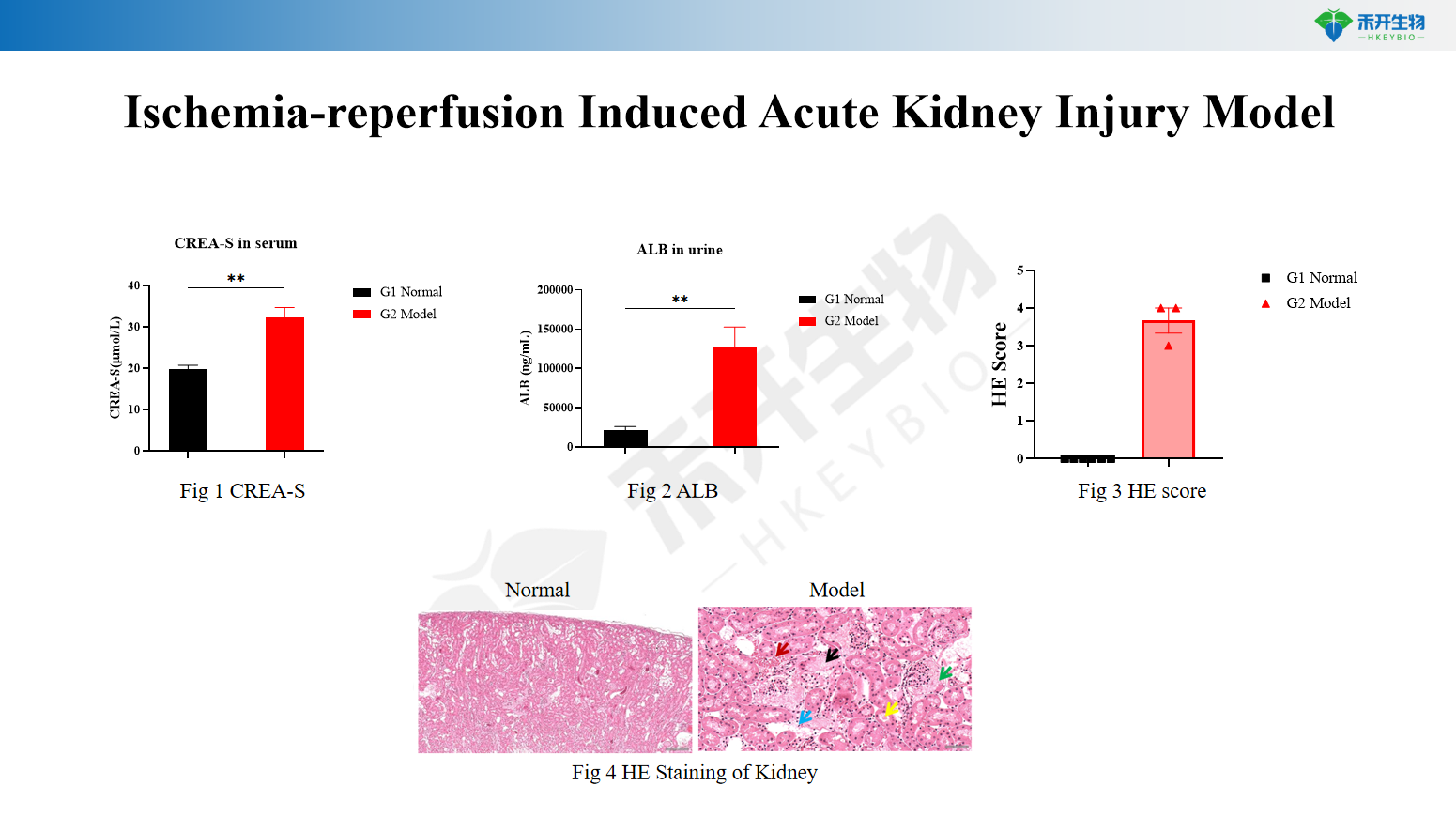
Comprehensive endpoints – Serum creatinine (CREA-S), albuminuria (ALB), renal histopathology (HE staining) with scoring for tubular injury, cast formation, and inflammation.
Mechanism-driven – Recapitulates key pathophysiological processes: hypoxia, oxidative stress, inflammation, and tubular cell death.
Translational value – Ideal for testing renoprotective agents, antioxidants, anti-inflammatory drugs, and cell-based therapies.
IND-ready data packages – Studies can be conducted in accordance with GLP principles.
Technical Data & Validation
Ischemia-reperfusion Induced Acute Kidney Injury Model
Applications
• Efficacy testing of renoprotective agents (antioxidants, vasodilators, anti-inflammatory drugs)
• Evaluation of cell-based therapies (MSCs, extracellular vesicles) and regenerative medicine approaches
• Target validation for ischemic injury pathways (hypoxia-inducible factors, oxidative stress, inflammation)
• Biomarker discovery (early kidney injury markers, inflammatory mediators)
• IND-enabling pharmacology and toxicology studies
Model Specifications
Parameter | Specification |
Species/Strain | C57BL/6 mouse |
Induction method | Bilateral renal pedicle clamping (20–45 min) under anesthesia, followed by reperfusion (24–72 hours) |
Study duration | Acute: 24–72 hours; subacute/chronic: up to 14 days (for AKI-to-CKD transition studies) |
Key endpoints | Serum creatinine (CREA-S), albuminuria (ALB), renal histopathology (HE staining with tubular injury score), optional: BUN, KIM-1, NGAL, oxidative stress markers (MDA, SOD), inflammatory cytokines (IL-6, TNF-α, MCP-1), TUNEL apoptosis assay |
Data package | Raw data, analysis reports, clinical chemistry, histology slides (HE), bioinformatics (optional) |
❓ Frequently Asked Questions
Q1: What AKI preclinical model do you provide? A1: We offer an ischemia-reperfusion induced acute kidney injury model using C57BL/6 mice for relevant drug research and evaluation.
Q2: What is the modeling mechanism? A2: Renal pedicle clamping causes renal ischemia and tubular epithelial cell damage. Reperfusion further induces oxidative stress and inflammation, successfully simulating the pathological process of clinical AKI.
Q3: What evaluation indicators are adopted? A3: We detect serum creatinine (CREA-S) and albumin (ALB) for renal function assessment, and conduct H&E staining to analyze kidney pathological lesions.
Q4: What is the experimental timeline? A4: The model is established via ischemia-reperfusion operation at 0 hour. All detections and observations are completed at 24 hours.
Q5: What are the advantages and applications? A5: This model features simple operation, short cycle and stable renal injury phenotypes. It is widely used for efficacy screening and mechanism study of renal protective drugs for acute kidney injury.


