Key Features & Benefits
Clinically relevant – LPS-induced ALI closely mimics human ALI/ARDS with acute inflammation, leukocyte infiltration, and pulmonary edema.
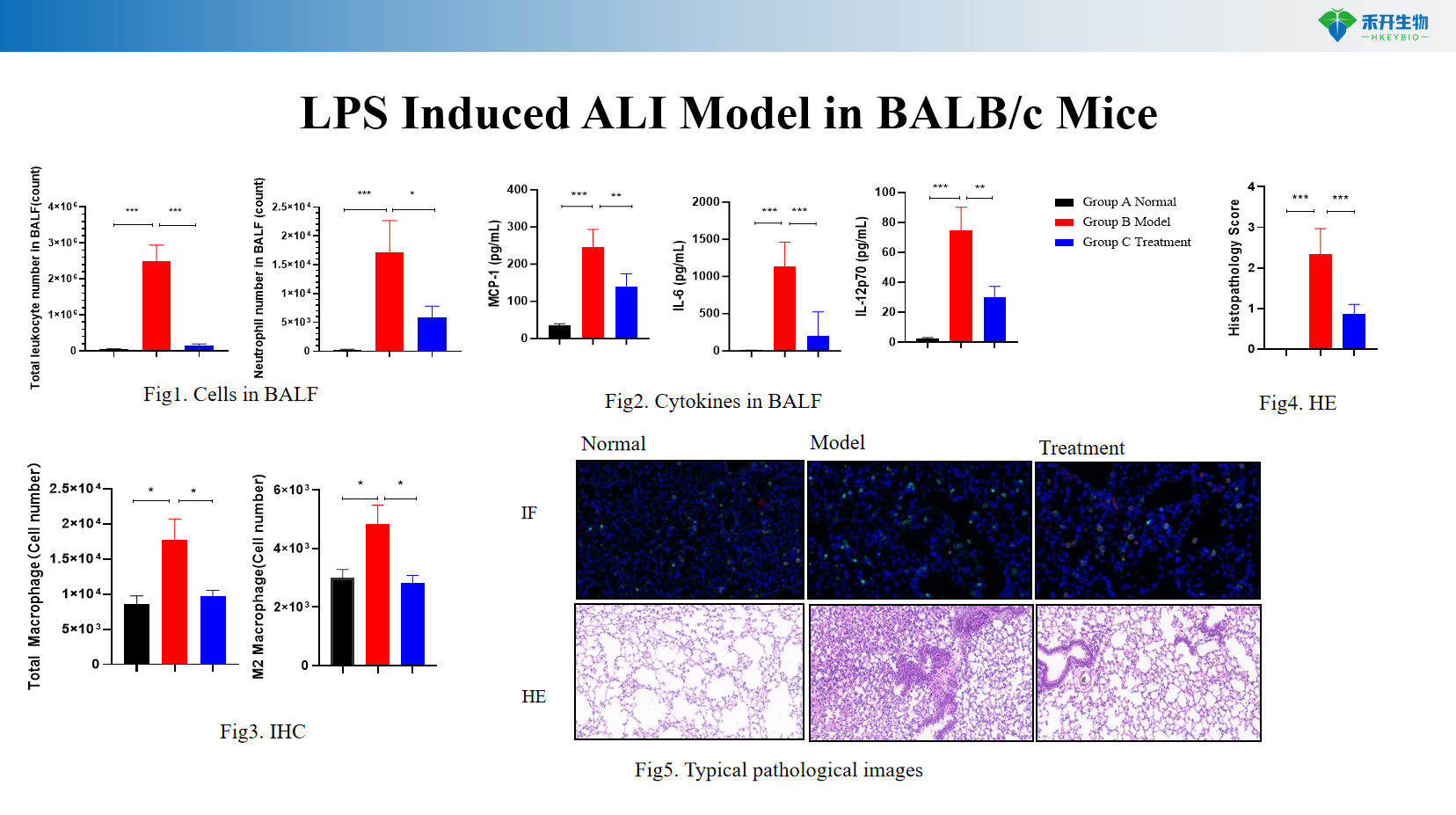
Comprehensive endpoints – BALF cell counts (lymphocytes, neutrophils, macrophages), cytokine profiling (MCP-1, IL-6, IL-10), lung histopathology (HE, IHC), pulmonary edema assessment (wet/dry ratio).
Mechanism-driven – LPS activates TLR4 signaling, triggering NF-κB pathway and robust inflammatory response, mirroring Gram-negative sepsis-induced lung injury.
Translational value – Ideal for testing anti-inflammatory drugs, cytokine inhibitors, neutrophil elastase inhibitors, and cell-based therapies.
IND-ready data packages – Studies can be conducted in accordance with GLP principles.
Technical Data & Validation
LPS Induced ALI Model in BALB/c Mice
Applications
• Efficacy testing of anti-inflammatory drugs (corticosteroids, NSAIDs), cytokine inhibitors (anti-IL-6, anti-TNF-α), and neutrophil elastase inhibitors
• Evaluation of mesenchymal stem cell (MSC) therapy and extracellular vesicle-based treatments
• Target validation for TLR4 signaling, NF-κB pathway, and inflammatory cascades
• Biomarker discovery (BALF cell profiles, cytokine signatures, lung injury markers)
• IND-enabling pharmacology and toxicology studies
Model Specifications
Parameter | Specification |
Species/Strain | BALB/c mouse |
Induction method | Intratracheal, intranasal, or intraperitoneal administration of lipopolysaccharide (LPS, 5–10 mg/kg) |
Study duration | Acute: 6–48 hours post-LPS administration |
Key endpoints | BALF cell counts (total and differential: neutrophils, macrophages, lymphocytes), BALF cytokine levels (MCP-1, IL-6, IL-10 by ELISA), lung histopathology (HE staining with lung injury score), immunohistochemistry (IHC) for inflammatory markers, lung wet/dry weight ratio (pulmonary edema), optional: MPO activity, oxidative stress markers |
Data package | Raw data, analysis reports, BALF cell counts, ELISA results, histology slides (HE, IHC), bioinformatics (optional) |
❓ Frequently Asked Questions
Q1: What ALI preclinical model do you provide? A1: We establish a classic acute lung injury model in BALB/c mice induced by Lipopolysaccharide (LPS).
Q2: What is the modeling mechanism? A2: LPS triggers severe lung inflammation, causing leukocyte infiltration, pulmonary edema and damage to lung epithelial and endothelial barriers, which closely mimics human ALI.
Q3: What evaluation indicators are used? A3: We detect lymphocytes, neutrophils and macrophages in BALF, test inflammatory cytokines including MCP-1, IL-6 and IL-10, and perform HE and IHC staining for pathological analysis.
Q4: What is the experimental timeline? A4: LPS is administered to induce injury. Drug treatment starts at 2 hours, and all samples and detections are completed at 24 hours.
Q5: What are the advantages and applications? A5: This model has rapid onset, stable lesions and high reproducibility. It is widely used for efficacy screening and mechanism research of drugs for acute lung injury and respiratory inflammation.


