Key Features & Benefits
Regulatory gold standard – TDAR is recommended by FDA, EMA, and ICH S8 as a first-choice immune function test for immunotoxicity assessment.
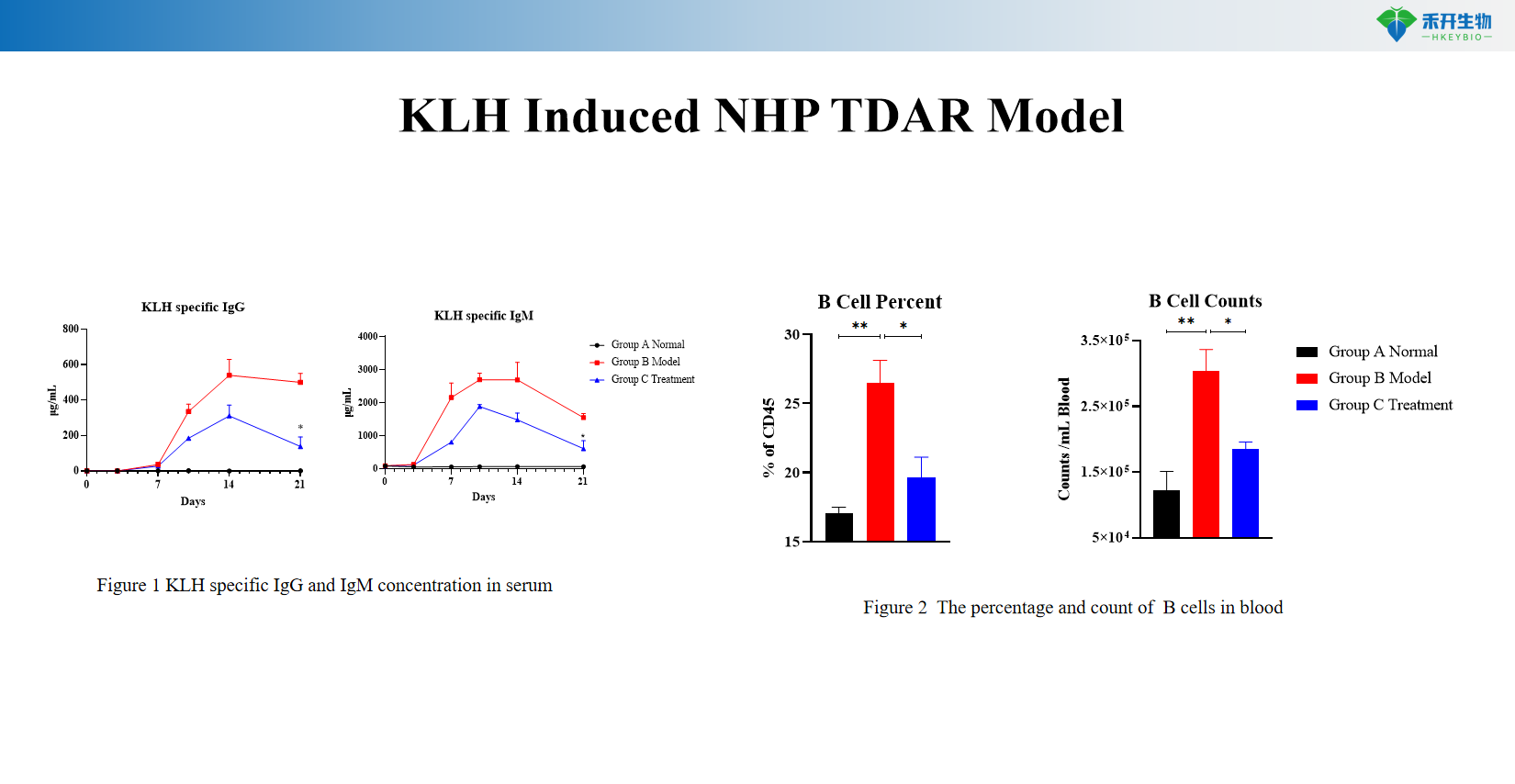
Comprehensive immune assessment Quantifiable endpoints – KLH-specific IgM and IgG titers; B cell phenotyping (percentage and absolute counts); primary and secondary response kinetics.
IND-ready data packages – Studies can be conducted in accordance with GLP principles for regulatory submissions.
Technical Data & Validation
Representative data from our KLH Induced NHP TDAR model:
KLH Induced NHP TDAR Model
Applications
• Immunotoxicity assessment of small molecules, biologics, and immunomodulators
• IND-enabling studies requiring immune function evaluation (ICH S8 compliance)
• Mechanism of action studies for immunosuppressive or immunostimulatory drugs
• Vaccine adjuvant evaluation
• Biomarker discovery for immune competence
Model Specifications
Parameter | Specification |
Species | Cynomolgus macaque (Macaca fascicularis) |
Induction method | Immunization with keyhole limpet hemocyanin (KLH), typically with adjuvant, intramuscular or subcutaneous administration |
Study duration | 4–8 weeks (primary and secondary response assessment) |
Key endpoints | KLH-specific IgM (day 7-14), KLH-specific IgG (day 14-28), B cell phenotyping (percentage and absolute counts), optional: T cell subsets, cytokine profiling |
Data package | Raw data, analysis reports, flow cytometry files, bioinformatics (optional) |
❓ Frequently Asked Questions
Q 1: What is the NHP TDAR model and what is it used for? A1: TDAR refers to T-Cell-Dependent Antibody Response. Our KLH-induced NHP TDAR model is a gold-standard preclinical assay to evaluate drug-induced immunotoxicity and assess overall immune competence.
Q2: What is the principle of the KLH induced NHP TDAR model? A2: Keyhole limpet hemocyanin (KLH) is a highly immunogenic protein. It triggers typical T-cell-dependent immune reactions, which can effectively detect the immunosuppressive effects of candidate drugs.
Q3: What detection indicators are included in this model? A3: We test serum anti-KLH IgM and IgG levels, as well as the percentage and absolute count of B cells in peripheral blood for comprehensive immune function analysis.
Q4: What is the modeling cycle and key time points? A4: KLH immunization is performed on Day 0. Sample collection and all relevant detections are completed by Day 21.
Q5: What are the advantages of using NHP for TDAR assessment? A5: Non-human primates share high similarity with humans in immune systems. The model delivers reliable and predictive data, which is ideal for immunotoxicity evaluation of novel drugs


