Key Features & Benefits
Clinically relevant – Recapitulates key features of multiple sclerosis pathology: oligodendrocyte loss, demyelination, gliosis, and motor dysfunction.
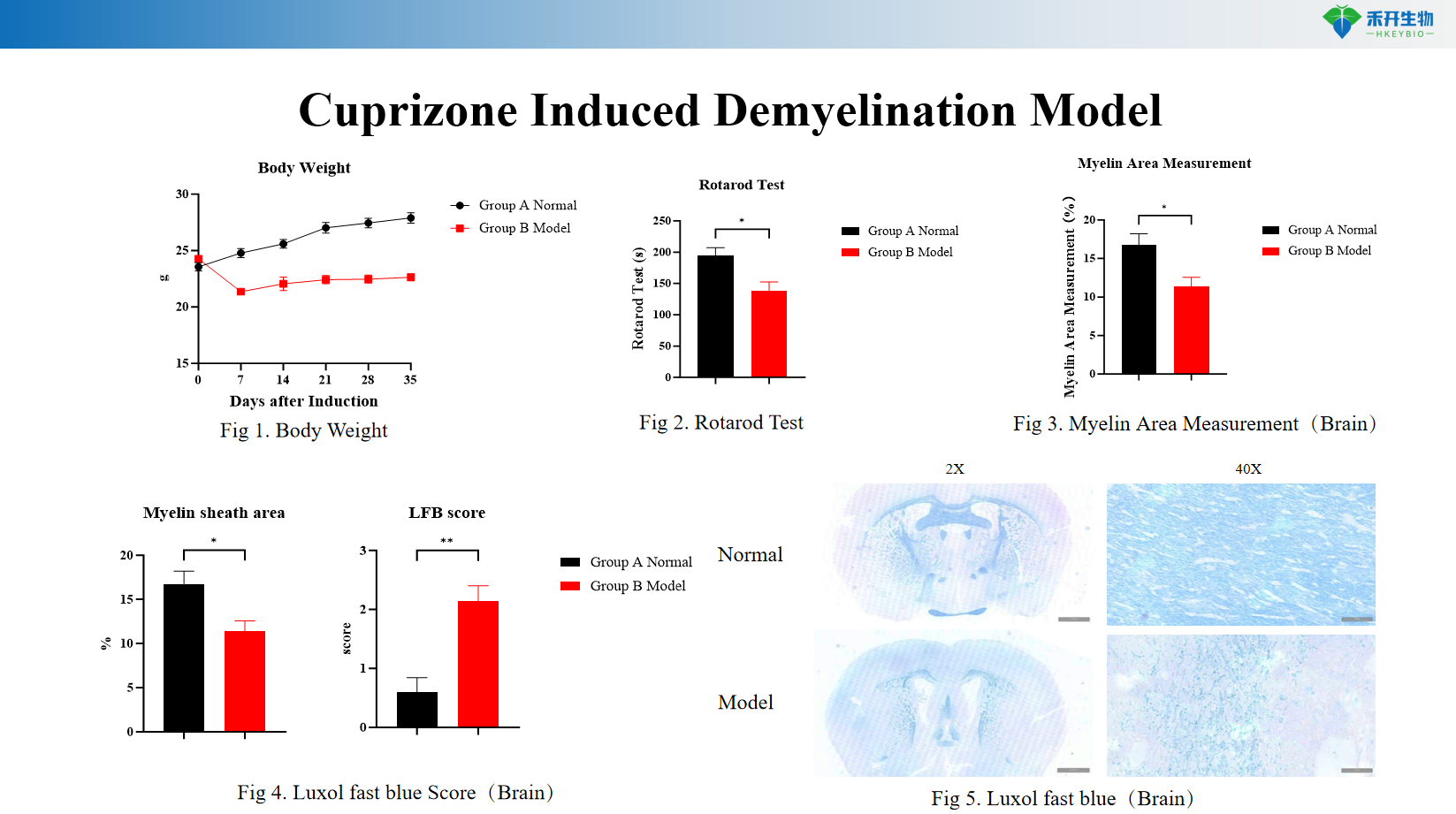
Quantifiable endpoints – Body weight, Rotarod test (motor coordination), myelin area measurement (histology), Luxol fast blue staining and scoring.
Mechanism-driven – Cuprizone induces oligodendrocyte stress through copper chelation, leading to mitochondrial dysfunction and apoptosis, with subsequent glial activation.
Translational value – Ideal for testing remyelinating therapies, neuroprotective agents, and anti-inflammatory drugs for multiple sclerosis and other demyelinating diseases.
IND-ready data packages – Studies can be conducted in accordance with GLP principles.
Technical Data & Validation
Cuprizone Induced Demyelination Model
Applications
• Efficacy testing of remyelinating therapies (anti-LINGO-1, muscarinic receptor antagonists, thyroid hormone agonists)
• Evaluation of neuroprotective agents and anti-inflammatory drugs for multiple sclerosis
• Target validation for oligodendrocyte survival and differentiation pathways
• Biomarker discovery (myelin proteins, glial markers)
• IND-enabling pharmacology and toxicology studies
Model Specifications
Parameter | Specification |
Species/Strain | C57BL/6 mouse |
Induction method | Dietary administration of 0.2–0.5% cuprizone mixed in standard rodent chow for 3–6 weeks |
Study duration | 3–8 weeks (demyelination phase) + optional 2–6 weeks (remyelination phase after cuprizone withdrawal) |
Key endpoints | Body weight, Rotarod test (motor coordination), myelin area measurement (histology, corpus callosum), Luxol fast blue staining and scoring, immunohistochemistry for oligodendrocytes (CC1, Olig2), astrocytes (GFAP), microglia (Iba1), optional: electron microscopy for myelin thickness, qPCR for myelin genes (MBP, PLP, MAG) |
Data package | Raw data, analysis reports, behavioral data, histology slides (LFB, IHC), image analysis files, bioinformatics (optional) |
❓ Frequently Asked Questions
Q1: What demyelination preclinical model do you provide? A1: We offer a cuprizone-induced demyelination model using C57BL/6 mice for central nervous system demyelination disease research.
Q 2: What is the modeling mechanism? A2: Cuprizone disrupts copper balance and causes mitochondrial dysfunction. It triggers oligodendrocyte injury, glial cell activation and myelin sheath loss, simulating pathological changes of human demyelinating disorders.
Q3: What evaluation indicators are adopted? A3: We monitor body weight and conduct Rotarod tests for motor function assessment. We detect IL-17 and Th1 cells, and perform Luxol fast blue staining to evaluate brain demyelination.
Q4: What is the experimental schedule? A4: Cuprizone is administered three times per day starting from Day 0. The whole experiment lasts 35 days until all tests are completed.
Q5: What are the advantages and applications? A5: This model features stable demyelinating lesions and easy operation. It is widely used for efficacy screening and mechanism study of drugs targeting demyelinating diseases.


